
Table of Contents
- Quick Summary: Key Takeaways for Anxious Pet Parents
- 1. Direct Clinical Answer: Why Is Your Dog Pacing and Panting at Night?
- 2. The Canine Nocturnal Shift: Understanding Nighttime Vulnerability
- 3. Silent Orthopedic Pain: Osteoarthritis and Spinal Spondylosis
- 4. Visceral Pain & Gastrointestinal Crises: The Hidden Internal Agony
🩺 Dr. Ahmed’s Immediate Clinical Triage
- Direct Cause: Nighttime pacing and heavy panting are hallmark clinical distress signals indicating physical pain, respiratory distress, cognitive dysfunction, or internal anxiety.
- The Core Mechanism: Panting without heat or exertion is driven by an adrenaline surge and elevated cortisol, meaning the dog cannot physically settle into deep REM sleep.
- Red Flag Emergency: A distended, hard abdomen, unproductive retching, or pale/blue gums require immediate, middle-of-the-night emergency hospitalization to rule out fatal gastric dilatation-volvulus (GDV/bloat).
- First Home Step: Assess resting respiratory rate, examine gum color, check joint mobility gently, and measure room temperature before attempting sedation.
1. Direct Clinical Answer: Why Is Your Dog Pacing and Panting at Night?
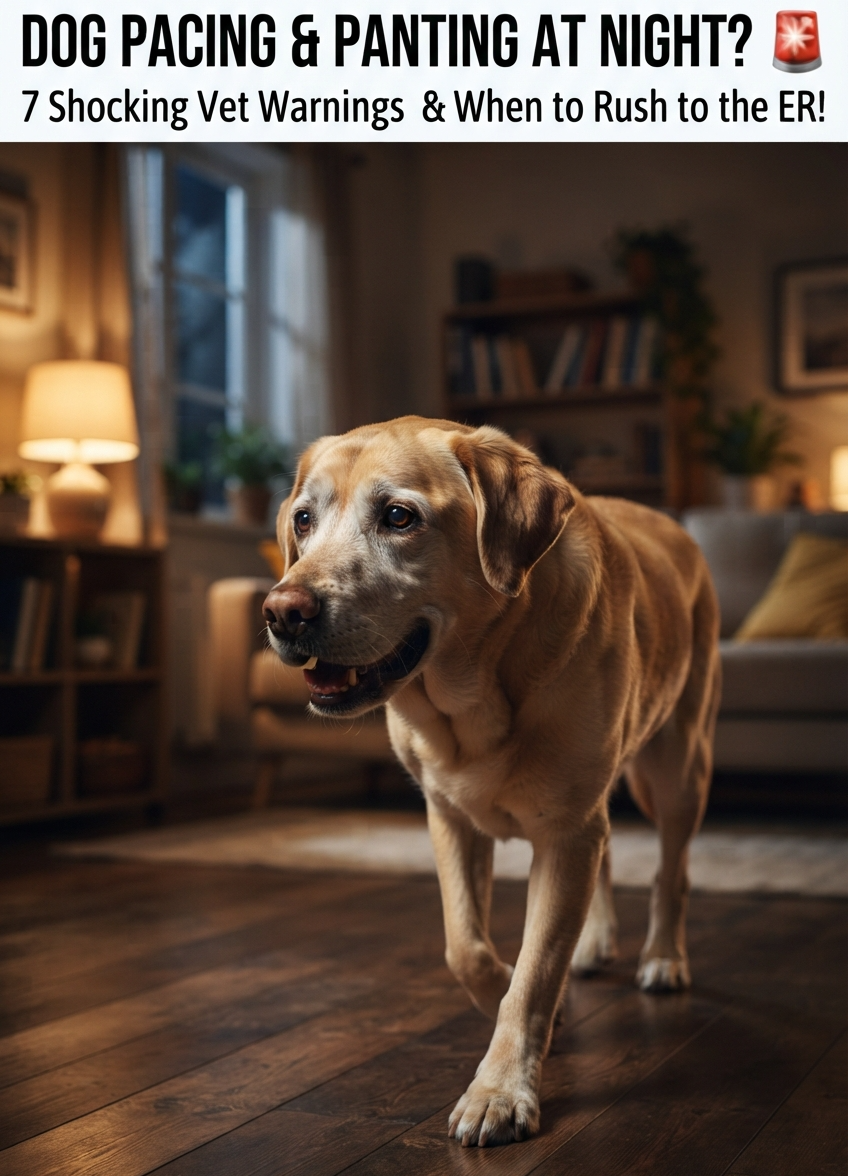
When a dog paces aimlessly and pants heavily at night, it is almost always a physical response to unmanaged pain, nocturnal anxiety, cognitive dysfunction, or an internal medical emergency. In my years of clinical emergency triage, healthy dogs do not pace in the dark without cause; their natural evolutionary instinct is to conserve energy and rest alongside their family pack.
Panting is the canine body’s primary thermoregulatory cooling mechanism, but it is also an involuntary physiological reaction to acute sympathetic nervous system stimulation. When adrenaline spikes due to deep physical agony or overwhelming mental confusion, heart rate elevates, breathing patterns double in speed, and the dog becomes physically incapable of lying still in a comfortable sleeping posture.
Seeing your beloved dog wander from room to room, panting heavily with wide, distressed eyes while the entire household is trying to sleep, is deeply distressing. However, panicking will only escalate your companion’s adrenaline levels. By methodically identifying the underlying triggers—ranging from stiff arthritic joints to life-threatening digestive emergencies—you can take clear, calm veterinary actions that bring immediate comfort and relief to your dog.

2. The Canine Nocturnal Shift: Understanding Nighttime Vulnerability
Why do these dramatic pacing episodes erupt predominantly when the sun goes down? To understand this frustrating nocturnal cycle, we must look at canine circadian biology and household dynamics. During daytime hours, daylight, outdoor sounds, human foot traffic, and visual distractions act as sensory white noise that helps mask low-grade discomfort.
When the house becomes silent and pitch-black, ambient distractions vanish completely. A dog experiencing chronic joint inflammation, high blood pressure, or early-stage neuro-degeneration is suddenly left alone with their internal sensations. Without daytime stimuli, mild physical sensations amplify into overwhelming distress.
Furthermore, canine cortisol levels follow a distinct circadian rhythm. In dogs suffering from endocrine imbalances such as Cushing’s disease (hyperadrenocorticism), nocturnal cortisol output spikes abnormally. This biochemical surge triggers sudden thirst, elevated metabolic heat, intense panting, and an unstoppable urge to walk restlessly across cool tile surfaces in a desperate attempt to find physical relief.
3. Silent Orthopedic Pain: Osteoarthritis and Spinal Spondylosis
By far the most common daytime-masked illness presented in my clinic is chronic orthopedic pain—specifically degenerative joint disease (osteoarthritis) and spinal spondylosis. Dogs are genetically programmed by their wild ancestor, the wolf, to hide physical weakness and limping during active waking hours to avoid appearing vulnerable.
However, when a dog with arthritic hips, elbows, or calcified spinal vertebrae attempts to lie down on a firm floor, their body weight concentrates immense pressure directly onto inflamed joint capsules. The act of lying flat compresses sensitive nerve endings, generating sharp or throbbing aches. Unable to tolerate the physical contact of the bed, the dog stands up, paces to relieve the ache, circles repeatedly, lies down in a new spot, and immediately gets back up as the pain recurs.
This endless standing-and-lying cycle is accompanied by heavy, shallow panting driven purely by physical agony. According to clinical guidelines from the American Veterinary Medical Association (AVMA), managing chronic canine pain requires multimodal therapy—combining orthopedic memory foam beds, veterinary-prescribed NSAIDs, and targeted joint lubricants—rather than dismissing nighttime restlessness as mere stubbornness or behavioral quirks.
If your canine companion also exhibits subtle morning stiffness or hesitation when jumping, explore our in-depth diagnostic guide on silent signs your dog is in pain to catch early degenerative joint disease before it destroys nighttime sleep quality.

4. Visceral Pain & Gastrointestinal Crises: The Hidden Internal Agony
While orthopedic aches develop gradually over months, sudden-onset nighttime pacing and panting often originates inside the abdominal cavity. Visceral pain—pain originating from internal organs like the stomach, pancreas, intestines, or bladder—is uniquely agonizing because it creates a deep, nauseating ache that cannot be relieved by changing body posture.
Conditions such as acute feline or canine pancreatitis, severe dietary indiscretion, or sudden intestinal cramping cause profound distress. When the stomach lining or pancreas becomes inflamed, lying on the abdomen puts direct pressure on the inflamed organs. Dogs will stand with their heads hung low, adopt a “prayer position” (front paws on the ground, rear end elevated in the air), and pace ceaselessly around the bedroom.
In high-risk deep-chested breeds such as Great Danes, Standard Poodles, and German Shepherds, sudden nighttime pacing accompanied by heavy panting, drooling, and unproductive retching is a critical symptom of Gastric Dilatation-Volvulus (GDV/Bloat). In GDV, the stomach fills with gas and twists on its mesenteric axis, cutting off blood supply to vital organs. This is a fatal condition that can cause death within two hours without emergency surgical decompression.
Is your dog’s abdomen also producing loud, abnormal digestive sounds during these midnight episodes? Review our emergency clinical breakdown on dog stomach gurgling and loss of appetite to recognize gastrointestinal inflammation before it turns into a life-threatening crisis.