
In This Feline Breed Guide
Clinical Summary at a Glance
- Maine Coons chirp and trill due to specialized vocal cord phonation, ancestral hunting traits, and high social bonding.
- Unlike open-mouth demanding meows, trills and chirps are closed-mouth vibrations designed for friendly pack communication.
- Ancestral Maine Coons utilized high-frequency acoustic contact calls to navigate dense northeastern forests without startling wild prey.
- Domesticated Maine Coons retain juvenile kitten vocalizations (neoteny) throughout adulthood to communicate affection to their human guardians.
The Direct Veterinary Answer
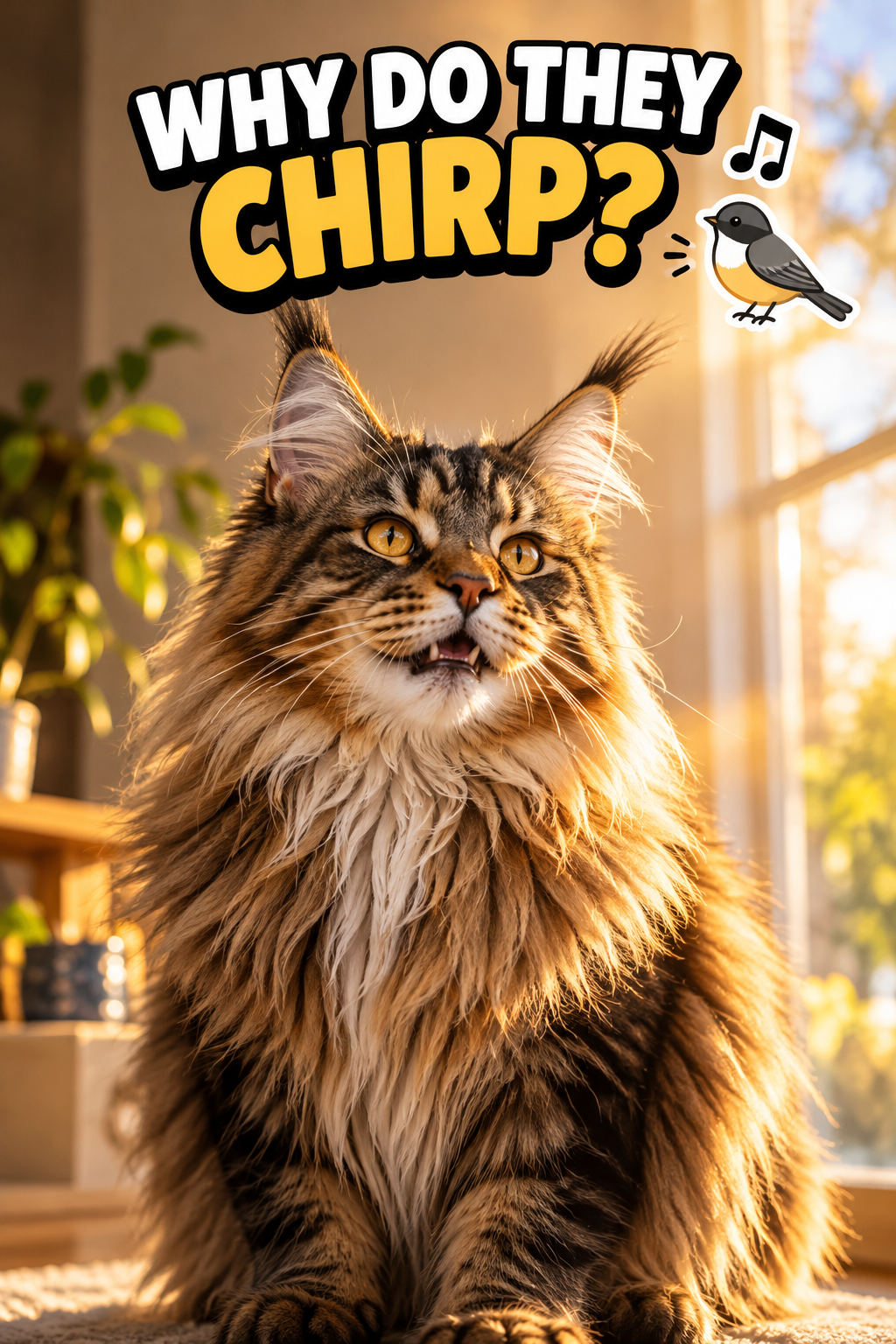
Why do Maine Coon cats chirp and trill instead of meow? Maine Coon cats chirp and trill due to a unique combination of specialized vocal tract biomechanics, ancestral forest communication instincts, and exceptional social neoteny. While a traditional meow requires an open mouth to project demand, chirps and trills are high-frequency, rolled vocalizations produced through a closed mouth and vibrating vocal cords, functioning as gentle, non-aggressive contact calls.
In feline behavioral biology, the Maine Coon breed evolved in dense northeastern American woodlands where visual tracking was hindered by snow and dense brush. High-pitched chirps cut through environmental white noise effortlessly without carrying the territorial aggression of a loud meow.
Furthermore, Maine Coons exhibit high domestic neoteny, retaining the gentle maternal trills queen cats use to guide kittens, repurposing this musical language to bond deeply with their human family.

Despite their massive physical stature, Maine Coons produce delicate, high-pitched acoustic vocalizations.
The Acoustic Biomechanics: How a 20-Pound Giant Sounds Like a Songbird
First-time Maine Coon owners often experience cognitive dissonance when their massive, fifteen-to-twenty-pound feline opens its mouth only to emit a soft, high-pitched chirp. The secret behind this acoustic contradiction lies in feline laryngeal and pharyngeal anatomy.
A standard feline meow is an overt, open-mouthed vocalization produced by forcing air across fully tensed vocal folds, creating an escalating vowel sound that ends with mouth closure. Cats typically reserve the open meow exclusively for demanding interactions with humans, such as requesting wet food or outdoor access.
Chirps and trills, by contrast, utilize closed-mouth phonation. As air passes through the larynx, the cat rapidly modulates the tension of the intrinsic thyroarytenoid muscles while keeping the lips sealed or barely parted.
This muscular flutter produces a rolling, voiced sound that resonates within the nasal cavity and sinuses rather than projecting outward as a raw bellow. The resulting acoustic signature registers at high frequencies between one and two kilohertz, creating the sweet, avian vibrato characteristic of the breed, as detailed in feline phonation studies at the Cornell Feline Health Center.
Chirp vs. Trill vs. Chatter: The Clinical Behavioral Matrix
To communicate effectively with your companion, you must distinguish between the three primary non-meow sounds Maine Coons frequently produce. Each vocalization carries a distinct physiological mechanism and behavioral intent:
1. The Chirp (The Avian Staccato)
The chirp is a short, abrupt, high-pitched staccato note lasting less than half a second. Cats produce chirps with a slight, sudden opening of the jaw, resembling a startled bird or squirrel squeak. Behaviorally, it signals positive alert status, such as spotting an interesting insect, welcoming an owner entering the room, or expressing playful curiosity.
2. The Trill (The Musical Chortle)
The trill is an undulating, rolling purr-meow produced with a completely closed mouth, often described phonetically as “brrr-r-r-o-o-w.” The pitch rises dynamically at the end of the note, creating a questioning inflection. Trills serve as intimate social greetings, invitations for physical affection, and polite requests to follow the cat to the food bowl.
3. The Chatter (The Predatory Tremor)
Chattering occurs when your Maine Coon stares intensely at birds or squirrels through window glass. It consists of rapid, clicking jaw vibrations paired with silent or squeaking rasps. Chattering is not a true vocalization; it is an involuntary, adrenaline-fueled motor reflex triggered by intense predatory frustration, mimicking the fatal neck-snapping bite felines deliver to prey.
Explore more about feline communication dynamics inside our behavioral archive on cat psychology and body language.

Window watching frequently sparks adrenaline surges that translate into rapid jaw-chattering clicks.
The New England Forest Origin: Evolutionary Stealth and Contact Calls
The Maine Coon is North America’s only native long-haired breed, descending from maritime seafaring cats brought to the rugged coastal regions of Maine in the eighteenth and nineteenth centuries. Natural selection in harsh, forested environments sculpted not only their water-resistant coats and snowshoe paws, but also their vocal habits.
In the dense underbrush and thick snowbanks of New England pine forests, deep acoustic signals travel poorly, bouncing erratically off frozen terrain. High-pitched chirps and rolling trills, however, carry extraordinary acoustic clarity over long distances.
More importantly, chirping mimics the ambient sounds of local fauna, such as thrushes, sparrows, and chipmunks. A loud, booming territorial meow would instantly alert rodents and prey to the presence of an apex ambush predator.
By relying on soft chirps, ancestral working farm cats communicated their locations to littermates and partners without broadcasting their presence to rodents or larger wilderness predators like bobcats and lynxes, as recognized by breed historians at the Cat Fanciers’ Association (CFA).
The Maternal Chortle and Feline Neoteny
In wild and feral cat colonies, mother queens use trills almost exclusively to shepherd and instruct their young. A queen emits a warm, vibrating trill when returning to the nest, signaling to her kittens that she brings food and that it is safe to emerge from hiding.
In most domestic breeds, kittens phase out these specialized sounds as they mature, transitioning to adult territorial meows, hisses, or silent independence. Maine Coons, however, display prolonged physical and neurological maturation, taking up to four full years to reach complete adulthood.
This prolonged developmental timeline fosters high feline neoteny—the retention of juvenile behavioral traits into adult life. To an adult Maine Coon, their human guardian occupies the emotional role of an honorary feline mother and pack leader.
When your Maine Coon greets you with an enthusiastic trill, they are utilizing the exact same nursery vocalization they shared with their mother. It is a profound neurological indicator of complete safety, emotional contentment, and familial attachment, a concept detailed in our guide to feline companion wellness.
Predatory Excitement vs. Frustration: The Science of Window Chattering
Few behaviors bewilder pet parents more than watching a massive Maine Coon sit motionless by a glass patio door, chattering their teeth rhythmically at passing birds. This distinctive staccato jaw-clicking is a complex neuro-motor reaction triggered by sensory visual stimulation.
When your cat spots a sparrow or squirrel just out of physical reach, their brain experiences a massive surge of dopamine and adrenaline. The visual pathway stimulates the trigeminal motor nucleus, prompting high-speed contractions of the masseter and temporalis jaw muscles.
Ethologists refer to this jaw movement as the vacuum killing bite. In the wild, felines deliver a rapid, targeted bite to the cervical vertebrae of prey to sever the spinal cord instantly.
Because the physical glass barrier prevents the cat from executing this instinctual takedown, the motor pattern fires into thin air, producing a clicking vibration paired with squeaky vocal chirps. It is an involuntary physical release valve for predatory arousal, as documented in feline behavior archives by The International Cat Association (TICA).
When Vocal Changes Signal Medical Danger in Maine Coons
While cheerful chirping and musical trilling indicate physical vitality, sudden modifications in your Maine Coon’s vocal acoustic profile warrant prompt clinical investigation. Feline vocal cords are delicate structures influenced heavily by thoracic pressure, neural integrity, and laryngeal health.
Because Maine Coons carry known genetic predispositions to specific hereditary disorders, keep a close ear on any changes in vocal volume, pitch, or clarity:
- Hypertrophic Cardiomyopathy (HCM): The most widespread genetic heart condition in Maine Coons causes thickening of the left ventricular walls, predisposing cats to congestive heart failure. As pulmonary fluid accumulates or enlarged cardiac chambers press against thoracic nerves, vocalizations become weak, muffled, or completely silenced.
- Nasopharyngeal Polyps: Young Maine Coons are prone to benign inflammatory polyps originating in the middle ear or eustachian tube that extend into the back of the throat. A dangling polyp acts as a physical damper on sound waves, transforming sweet trills into harsh, rattling snores or raspy wheezes.
- Laryngeal Paralysis and Upper Respiratory Infections: Feline herpesvirus (FHV-1) and calicivirus trigger severe mucosal ulceration and laryngeal inflammation. If your cat develops aphonia (complete voice loss) or sounds hoarse while chirping, bacterial laryngitis or nerve inflammation may be present.

Monitoring daily vocal patterns helps identify early cardiovascular and upper respiratory changes in pedigree cats.
How to Talk Back to Your Maine Coon: Strengthening Interspecies Bonding
Maine Coons are exceptionally communicative companions that treat human vocal replies as authentic social dialogue. When your cat trills to greet you at the door, failing to acknowledge their vocalization can leave them feeling socially isolated.
You do not need to reproduce a perfect feline trill to communicate successfully. Responding with a soft, cheerful, high-pitched vocal inflection confirms that their contact call was received and understood.
Combine your vocal reply with slow, deliberate blinks (the universal feline kiss) and an outstretched index finger offered for scent verification. Acknowledging their musical greetings stimulates oxytocin release in your cat’s brain, deepening the attachment bond naturally.
If your companion trills persistently while pacing toward their food station, use this moment for cognitive training. Pair your response with puzzle feeders or interactive play before serving balanced meals, as outlined in our guide to feline dietary management.
Acoustic Vocal Matrix: Decoding the Maine Coon Sound Spectrum
Use this clinical acoustic reference table to understand what your Maine Coon is communicating through their varied vocal repertoire:
| Sound Type | Acoustic Phonation | Frequency Range (Hz) | Behavioral Meaning | Recommended Human Action |
|---|---|---|---|---|
| The Chirp | Staccato, mouth slightly parted | 1,000 – 2,500 Hz (High) | Excited alert, spotted prey, friendly surprise | Acknowledge visual target; offer interactive toy. |
| The Trill | Closed-mouth rolling purr-vowel | 500 – 1,200 Hz (Musical) | Affectionate greeting, follow-me call, contentment | Reply with soft voice; offer chin and cheek scratches. |
| The Chatter | Rapid jaw clicking, rhythmic clicks | Variable mechanical sound | Predatory arousal, visual barrier frustration | Provide indoor hunting outlet with feather wand. |
| The Standard Meow | Open mouth closing at terminus | 700 – 1,500 Hz (Projected) | Urgent demand, hunger, distress, door access | Address physical requirement (food, water, clean litter). |
| The Silent Meow | Mouth opens wide, zero audible sound | Ultrasonic (>20,000 Hz) | Ultra-intimate bond, intense polite appeal | Reward immediately with gentle cuddle or treat. |
Frequently Asked Questions
Do Maine Coon cats ever meow like normal cats?
Yes, Maine Coons can produce standard meows, but they use them far less frequently than other breeds. They typically reserve open-mouthed meows for moments of genuine physical urgency, extreme hunger, or severe distress, preferring musical trills for daily social communication.
Why does my Maine Coon trill every time I touch them?
When your cat trills upon physical contact, it is an involuntary acoustic acknowledgment of social connection. Originating from maternal kitten interactions, this touch-activated trill translates to: “I see you, I feel you, and your presence is safe and welcome.”
Are male Maine Coons more vocal than females?
Both sexes are exceptionally vocal, but they use sounds slightly differently. Intact or newly neutered males often chirp to establish territorial presence, while females frequently produce rolling maternal trills when socializing with their human family pack.
What does it mean if my Maine Coon suddenly stops trilling?
Sudden voice loss or a decline in vocal activity in a normally chirpy Maine Coon is a clinical red flag. It frequently indicates upper respiratory tract viral infections, pharyngeal pain, dental root abscesses, or early cardiovascular fatigue from hypertrophic cardiomyopathy.
Professional Veterinary Ethological Disclaimer: The acoustic analyses, behavioral matrices, and medical correlations provided in this guide are intended for educational and companion animal understanding purposes only. Sudden vocal changes, hoarseness, lethargy, or loss of voice require diagnostic examination, cardiovascular screening, and laryngeal evaluation by a licensed veterinarian. If your feline demonstrates open-mouth panting, respiratory distress, or extreme vocal pain, seek emergency veterinary medical care immediately.