
In This Clinical Breed Guide
Clinical Summary at a Glance
- French Bulldogs suffer breathing crises at night due to Brachycephalic Obstructive Airway Syndrome (BOAS) aggravated by muscle relaxation during sleep.
- During deep sleep, pharyngeal muscle tone relaxes completely, allowing an elongated soft palate to fall backward and obstruct the larynx.
- Snoring, snorting, and sleep apnea are severe clinical signs of upper respiratory obstruction, not harmless breed quirks.
- Violent nighttime inhalation generates extreme negative intrathoracic pressure that pulls stomach acid into the esophagus, inflaming the pharynx.
The Direct Veterinary Answer
Why are French Bulldogs so prone to breathing problems at night? French Bulldogs suffer acute breathing problems at night because their severe anatomical skull compression—known as Brachycephalic Obstructive Airway Syndrome (BOAS)—collides with nocturnal muscle relaxation and gravitational pull. When a Frenchie enters deep REM sleep, the pharyngeal muscles that hold their narrow upper airway open lose tone and relax completely.
Without active muscular tension, their abnormally thickened, elongated soft palate flops backward against the base of the tongue, functioning like a fleshy mechanical check valve over the windpipe. Lying horizontally on their stomach or side intensifies this airway occlusion, triggering chronic obstructive sleep apnea, dangerous drops in blood oxygen saturation, and sudden choking arousals.
Understanding the severe anatomical reality behind nocturnal breathing collapse allows pet parents to implement protective sleep environments and seek life-saving airway surgical interventions before permanent laryngeal failure occurs.

Artificial selective breeding has compressed the canine facial skeleton while soft oral tissues remain fully sized.
The Physics of Nocturnal Collapse: How Gravity and REM Sleep Interlock
To understand why daylight brings noisy breathing but darkness brings life-threatening asphyxiation, we must evaluate canine sleep physiology. During active waking hours, a French Bulldog’s brain maintains constant, high-alert sympathetic tone to the pharyngeal dilator muscles.
These tiny muscles work overtime every single second, physically pulling the swollen soft palate forward and stiffening the pharyngeal walls to keep an artificial airway open. The dog expends tremendous caloric energy simply staying awake and moving air into their lungs.
The moment your Frenchie descends into restorative Rapid Eye Movement (REM) sleep, their central nervous system switches off voluntary muscle control, inducing systemic motor atony. The pharyngeal dilator muscles relax instantly, causing the heavy, flaccid soft tissues to collapse inward under atmospheric pressure.
When the dog lies in a natural recumbent posture, gravity pulls the tongue and thickened palate straight down into the laryngeal opening. The dog struggles against this mechanical blockade, entering a state of obstructive sleep apnea (OSA) where air cannot reach the alveolar sacs, as demonstrated in pioneering clinical trials by the Cambridge University BOAS Research Group.
The 4 Anatomical Malformations of Canine BOAS
Selective breeding for flat, baby-like facial features has drastically shortened the cranial bones of the French Bulldog without reducing the volume of the soft tissues packed inside. The result is a severe biomechanical traffic jam composed of four primary anatomical defects:
1. Stenotic Nares (Pinched Nostrils)
Over eighty percent of French Bulldogs present with stenotic nares, where the nasal wing cartilages (alr folds) collapse inward, creating narrow vertical slits. Breathing through stenotic nares is the physiological equivalent of attempting to breathe through a flattened drink straw, forcing the dog to generate massive negative pressure with every inhale.
2. Elongated and Thickened Soft Palate
The soft palate is designed to seal the nasopharynx during swallowing. In French Bulldogs, the palate is not only far too long—extending deep into the laryngeal vestibule—but is also markedly thickened with excess fibrous adipose tissue that occupies up to eighty percent of the throat lumen.
3. Everted Laryngeal Saccules
Laryngeal saccules are tiny pockets of mucous membrane located just forward of the vocal folds. Under the relentless vacuum pressure generated by struggling against stenotic nares, these delicate saccules turn completely inside out, protruding directly into the airway and obstructing airflow further.
4. Hypoplastic Trachea (Narrow Windpipe)
Many French Bulldogs are born with an abnormally underdeveloped, narrow trachea where the cartilage rings overlap tightly. Instead of a wide, rigid pipe, air must travel down a constricted passage, exponentially increasing airway resistance, as detailed in canine surgical protocols from the American College of Veterinary Surgeons (ACVS).

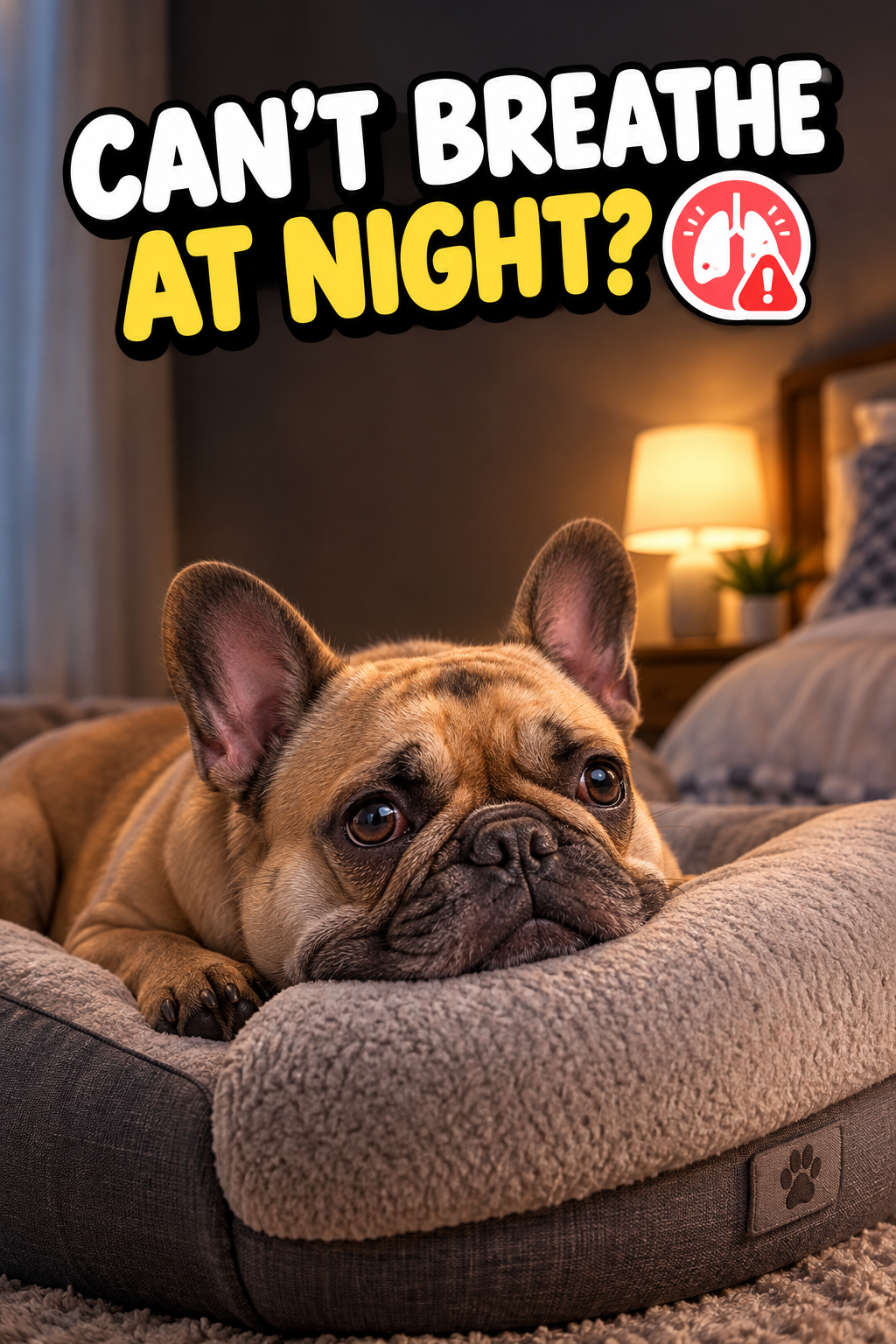
Supportive bedding allows brachycephalic breeds to keep their upper airways clear during rest.
The Dangerous Myth: Why “Cute Frenchie Snoring” Is Chronic Suffocation
Social media platforms have normalized loud French Bulldog snoring, framing it as an adorable breed signature that makes great video content. From a clinical veterinary standpoint, loud snoring is never benign; it is the sound of turbulent airflow vibrating through an obstructed, suffocating airway.
Every raspy snort and sawing rattle represents the soft palate flapping violently against inflamed pharyngeal walls. This continuous mechanical friction produces chronic tissue edema, causing the already oversized palate to swell even larger by morning.
Worse, this turbulent struggle triggers chronic systemic hypoxia. Over months and years, repeated drops in blood oxygen saturation force the heart to pump harder against constricted pulmonary capillaries, leading directly to pulmonary hypertension and right-sided congestive heart failure.
Dismissing nighttime breathing struggle as “just what Frenchies do” denies companion animals medical relief from agonizing, chronic air hunger. Explore our comprehensive archive on managing breed-specific orthopedic and respiratory challenges inside our guide to canine preventive medicine.
The Negative-Pressure Acid Reflux Loop
One of the most destructive, overlooked complications of nighttime BOAS is chronic gastrointestinal regurgitation. The physical mechanism linking the lungs and the stomach is straightforward biomechanics.
When a sleeping Frenchie attempts to inhale through a collapsed throat, their powerful diaphragm contracts vigorously against a closed airway. This creates massive negative intrathoracic pressure within the chest cavity, functioning exactly like a suction syringe.
This internal vacuum pulls gastric hydrochloric acid, bile, and half-digested kibble upward past the lower esophageal sphincter into the esophagus and larynx. The caustic stomach acid bathes the delicate laryngeal tissues, causing severe chemical burns, chronic esophagitis, and acute pharyngeal swelling.
The swollen pharynx narrows the airway even further, generating even higher negative suction on the next breath. This creates a relentless, vicious cycle: obstructed breathing drives acid reflux, and acid reflux swells the airway until the dog wakes up choking on white foamy bile, a clinical reality detailed in our guide to canine gastrointestinal health.
Orthopneic Sleeping Postures: Why Frenchies Sleep Sitting Up or With Toys
If you observe your French Bulldog sleeping with their chin propped high on the bolster edge of their bed, sleeping completely sitting up, or keeping a rubber toy wedged between their jaws overnight, they are not acting cute. These behaviors are clinical orthopneic survival postures adopted unconsciously to prevent fatal suffocation.
When a Frenchie props their chin on an elevated pillow, they use gravity to pitch their elongated soft palate forward away from the glottis. Extending the cervical spine straightens the upper respiratory tract, creating a wider mechanical channel for air to pass into the lungs.
Sleeping with a tennis ball or chew toy clamped between the teeth is an ingenious physiological adaptation. The toy functions as an artificial bite-block, preventing the lower jaw from closing completely and keeping the thick tongue anchored forward in the mouth.
This physical gap preserves a continuous oral airway, allowing air to bypass obstructed, pinched nostrils entirely during deep sleep cycles. Recognizing that your dog is using furniture and toys to keep themselves alive is the first step toward seeking surgical and environmental intervention, as highlighted by clinical behaviorists in our guide to canine behavioral health.
Emergency Red Flags: When Nighttime Breathing Becomes Fatal
Because French Bulldogs possess zero anatomical reserve during respiratory distress, nighttime sleep apnea can spiral into fatal asphyxiation within minutes. Pet owners must differentiate between typical noisy brachycephalic breathing and acute respiratory arrest.
Transport your dog to an emergency 24-hour veterinary facility immediately if you observe any of the following nocturnal red flags:
- Cyanotic Mucous Membranes (Blue or Gray Gums): Inspect your dog’s tongue and inner lips during a choking episode; a lavender, gray, or dark blue tint indicates life-threatening tissue hypoxia.
- Unresponsive Apnea Events Lasting Over 20 Seconds: The dog stops breathing entirely during sleep, followed by violent chest spasms, panic awakening, and frantic gasping for air.
- Nocturnal Hyperthermia (Heatstroke): Inefficient panting causes body heat to build rapidly; if your Frenchie’s rectal temperature exceeds 103.5 degrees Fahrenheit (39.7 degrees Celsius) in a cool room, systemic heatstroke is setting in.
- Producing Frothy White or Pink Bile: Throwing up voluminous white froth or pink-tinged pulmonary fluid indicates developing non-cardiogenic pulmonary edema from negative-pressure lung damage.
- Complete Physical Collapse or Syncope: Fainting or sudden hind-limb weakness upon waking from sleep indicates catastrophic oxygen deprivation to the cerebral cortex.

Elevating the head on specialized bolster beds relieves gravitational weight from the canine trachea.
The Veterinary Bedroom Protocol: 5 Life-Saving Nighttime Rules
While definitive corrective surgery is the gold standard for severe BOAS, optimizing your French Bulldog’s physical sleeping environment dramatically reduces nighttime airway collapse. Implement these five clinical environmental rules immediately:
- Strict Ambient Climate Control (68°F to 72°F): Maintain bedroom air conditioning between sixty-eight and seventy-two degrees Fahrenheit year-round. Warm, stagnant air triggers rapid panting, which quickly inflames and swells the pharyngeal tissues, worsening night blockages.
- Deploy an Orthopedic Bolster Bed: Retire flat sleeping cushions in favor of medical-grade memory foam beds featuring continuous, firm raised bolsters. The raised perimeter naturally elevates your Frenchie’s head and chin, utilizing gravity to keep the soft palate from sliding backward.
- Manage Ambient Room Humidity (40% to 50%): Dry air parches delicate mucous membranes, accelerating sticky mucus accumulation that clogs narrow nasal passages. Run a cool-mist ultrasonic humidifier in the bedroom to keep airway secretions thin, lubricated, and easy to clear.
- Enforce an Early Evening Feeding Window: Feed your dog their final meal of the day at least four to five hours before bedtime. An empty stomach eliminates full gastric volume, minimizing nocturnal acid reflux and preventing hiatal sliding hernias during sleep.
- Eliminate Heavy Bedtime Exercise: Avoid vigorous play, excitement, or outdoor evening walks within two hours of sleeping. Calming your dog’s heart rate ensures they enter sleep cycles with minimal baseline airway inflammation, as outlined in our guide to preventative canine care.
Surgical Airway Interventions: When to Open the Airway
When conservative environmental management fails to stop obstructive sleep apnea, surgical airway modification becomes a life-saving necessity. Board-certified veterinary surgeons utilize advanced CO2 lasers and radiofrequency devices to remodel the upper respiratory architecture.
The primary surgical procedure is Ala-vestibuloplasty (Stenotic Nares Resection), where wedges of obstructing nasal cartilage are amputated to widen the nostrils permanently. This single procedure slashes upper airway resistance by over fifty percent, instantly reducing the negative vacuum pressures that collapse the throat.
Concurrently, surgeons perform a Folded Flap Palatoplasty or Laser Staphylectomy to shorten and thin the hypertrophied soft palate. By amputating the redundant caudal edge of the palate and repositioning the tissue, the surgeon clears the entrance to the larynx, eliminating the physical obstruction that causes nocturnal snoring.
If the laryngeal saccules have already everted into the airway, they are excised surgically during the same anesthetic session. Operating between nine and twenty-four months of age is optimal; waiting until late adulthood allows chronic vacuum pressures to trigger irreversible, fatal laryngeal collapse, as documented by surgical specialists at the American College of Veterinary Surgeons (ACVS).
Diagnostic Decision Matrix: Harmless Breathing vs. Severe Nocturnal BOAS
Use this clinical decision matrix to evaluate your French Bulldog’s nighttime respiratory distress level:
| Clinical Parameter | Mild / Manageable BOAS | Severe Nocturnal Obstruction | Veterinary Action Required |
|---|---|---|---|
| Snoring Volume & Quality | Soft, rhythmic rhythmic humming | Loud, sawing, rattling, choked snorts | Sedated upper airway examination |
| Sleeping Posture | Curled on side or relaxed on belly | Sleeps sitting up, neck extended, chin on toys | Switch to orthopedic bolster beds immediately |
| Sleep Continuity | Rests peacefully through the night | Wakes gasping every 20-30 minutes; restless | Surgical evaluation for soft palate resection |
| Nocturnal Acid Reflux | No coughing or lip-smacking | Frequent regurgitation of white foam, hard swallows | Prescribe proton pump inhibitors & early dinner |
| Mucous Membrane Color | Healthy salmon pink tongue and gums | Pale, lavender, or bluish-gray hue | Immediate Hospitalization (Oxygen Emergency) |
Frequently Asked Questions
Is snoring always a sign of airway disease in French Bulldogs?
Yes, loud snoring is never normal or healthy for any dog. While extremely common in brachycephalic breeds, snoring is the physical vibration of an elongated, thickened soft palate obstructing airflow, signaling chronic upper respiratory resistance that warrants veterinary evaluation.
Can French Bulldogs die in their sleep from breathing problems?
Yes, severe untreated BOAS can cause fatal nighttime respiratory arrest. If deep sleep induces complete airway collapse and the dog is too exhausted or heavily sedated to wake up, acute hypoxia triggers cardiac arrhythmias, non-cardiogenic pulmonary edema, and sudden nocturnal death.
What age should a French Bulldog have BOAS surgery?
Veterinary surgeons recommend performing corrective BOAS surgery (stenotic nares widening and soft palate trimming) between nine and eighteen months of age. Correcting the airway early prevents years of chronic negative pressure from permanently collapsing the laryngeal cartilages.
Does weight loss help a French Bulldog breathe better at night?
Yes, maintaining a lean body condition is one of the most effective non-surgical treatments for BOAS. Overweight dogs accumulate thick fat deposits within the soft palate and pharyngeal walls, narrowing the already constricted airway even further.
Professional Veterinary Medical Disclaimer: The respiratory evaluations, anatomical assessments, and environmental guidelines provided in this article are intended for educational and pet safety purposes only. Brachycephalic airway syndrome requires individualized physical examination, thoracic radiography, and sedated airway staging by a licensed veterinary practitioner. If your French Bulldog exhibits blue gums, continuous gasping, hyperthermia, or collapse, seek emergency veterinary medical care immediately.