
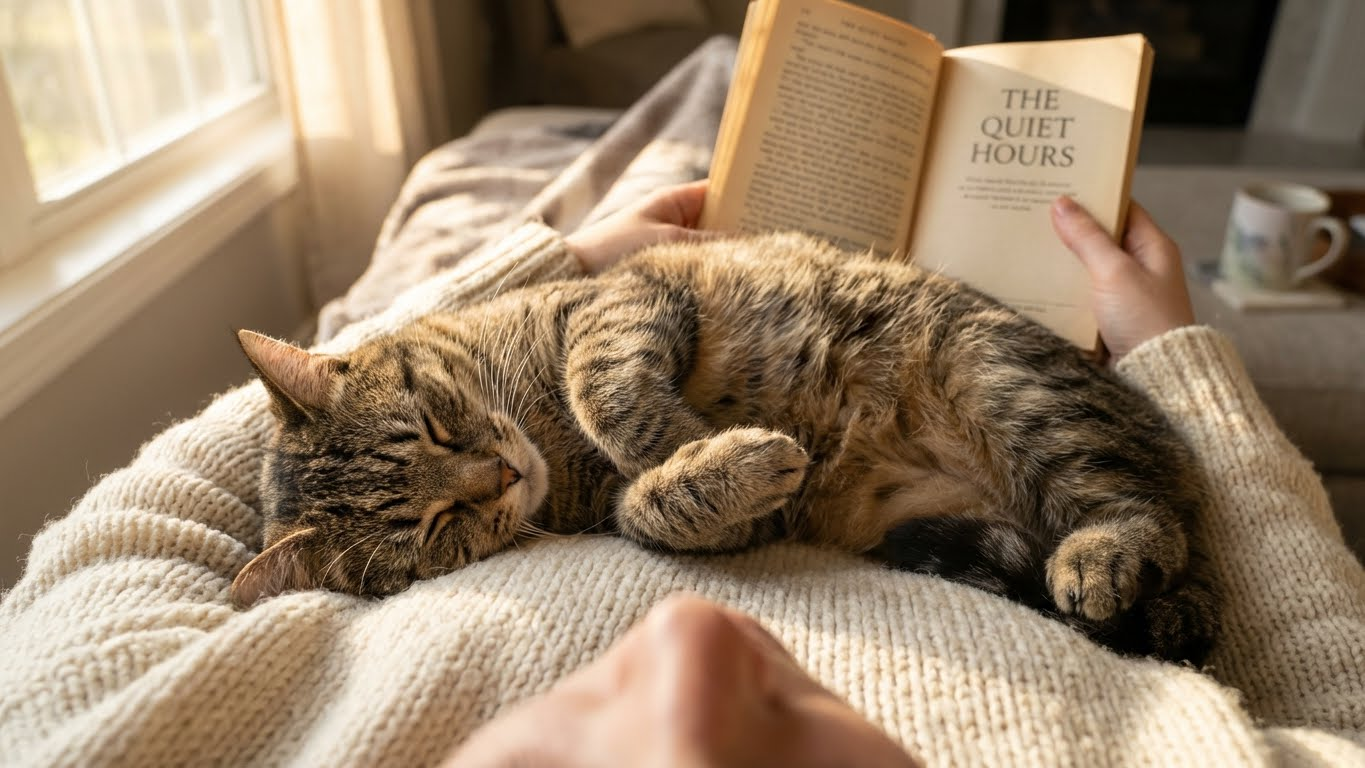
It is a familiar scenario for many cat owners: You are lying in bed, ready to drift off to sleep, or perhaps you are relaxing on the couch after a long day. Suddenly, you feel a gentle (or sometimes heavy) weight settle right on top of you. Your feline friend has decided that your chest is the absolute best place in the world to nap.
While it can be comforting to hear their rhythmic purring and feel their warmth, you might find yourself wondering: Why here? Of all the comfortable spots in the house—the expensive cat bed, the sunny windowsill, or even the foot of the bed—why does my cat sleep on my chest?
Is it a sign of affection? Is it a dominance display? Or are they just using you as a human heating pad?
As experts in Cat Behavior & Psychology, we are here to decode this adorable (and sometimes suffocating) behavior. In this comprehensive guide, we will explore the deep psychological and physiological reasons behind this habit, what it says about your bond, and when you might need to reclaim your personal space.
The Quick Answer: Why Do They Do It?
Many owners ask: why does my cat sleep on my chest instead of its bed? Here is the simple reason.
If you are looking for a quick explanation, here is the summary. When you ask, “Why does my cat sleep on my chest?“, the answer is usually a combination of:
-
Security: You are their “safe place” and protector.
-
Bonding: It is the ultimate sign of trust and love (“Pillowing”).
-
Warmth: Your chest radiates heat, and cats love high temperatures.
-
Heartbeat: The sound of your heart is soothing and reminds them of their mother.
The Psychology: Why Does My Cat Sleep on My Chest? (9 Reasons)
To truly understand our feline friends, we have to look at the world through their eyes. Here are the 9 detailed reasons why your cat insists on sleeping on top of you.
1. The Ultimate Sign of Trust (The “Pillowing” Effect)
In the wild, a sleeping animal is a vulnerable animal. Cats are both predators and prey, meaning they are constantly on high alert. When a cat closes its eyes to sleep deeply, they are putting themselves at risk.
By choosing to sleep on your chest, your cat is saying, “I trust you completely.” They know you are not a threat, and more importantly, they believe you will protect them if a threat appears. In animal behavior psychology, this is often referred to as “pillowing,” a communal sleeping habit used to strengthen social bonds.
2. Seeking Warmth (The Thermoregulation Factor)
This is the most practical reason. A cat’s normal body temperature is between 101°F and 102.5°F (38°C – 39°C), which is higher than ours. Because of this, they have a harder time maintaining body heat when they are inactive.
Your chest and torso are the warmest parts of your body. When you ask, “Why does my cat sleep on my chest?“, the answer might be as simple as: you are a giant, living radiator. They are instinctively seeking the warmest spot to conserve their own energy while they sleep.
3. The Soothing Sound of Your Heartbeat
Have you ever wondered why kittens sleep in a pile with their mother? It’s not just for warmth; it’s for the rhythmic sound of her heartbeat and breathing. This sound signifies safety and comfort.
Even adult cats retain some “kitten-like” behaviors towards their owners. Lying on your chest places their ears directly over your heart. The steady rhythm of your heartbeat and the rise and fall of your chest as you breathe can act as a natural lullaby, reducing their anxiety and helping them sleep deeper.
4. You Are Their Territory (Scent Marking)
Another answer to ‘why does my cat sleep on my chest‘ is territorial instinct.
Cats are territorial creatures who communicate heavily through scent. They have scent glands all over their bodies, including their paws, cheeks, and tails.
By sleeping on you, they are effectively “claiming” you. They are mixing their scent with yours, creating a “group scent” that signals to any other animals (or humans) that you belong to them. It is a possessive, yet affectionate, display of ownership.
5. High Ground Advantage
In the wild, high ground offers a strategic advantage. It allows a cat to survey their surroundings and spot potential predators or prey.
While your bed isn’t a jungle, your chest is often the highest point of the bed when you are lying down. By perching on top of you, your cat gets a better vantage point of the room (even if their eyes are closed, they feel safer being elevated).
6. Anxiety and Stress Relief
Does your cat tend to sleep on you more when you have been away at work all day? Or maybe when there are loud noises outside, like thunder?
Cats can suffer from separation anxiety. When you return, they may cling to you to reassure themselves that you are really there. The physical contact releases oxytocin (the love hormone) in both the cat and the human, significantly lowering stress levels.
7. Your Chest is the Most Stable Spot
Compared to your legs or arms, which might twitch or move during the night, your torso is a relatively stable platform. Cats are light sleepers and dislike being disturbed. Your chest provides a broad, flat, and steady surface that allows them to relax fully without the fear of being kicked off.
8. The “Over-Protective” Cat
Sometimes, the role is reversed. It’s not that they need protection; they think you do. In a multi-cat household, or if there is a new baby or pet, your cat might sleep on your chest to “guard” you. It is a way of blocking access to you from other members of the household.
9. They Just Missed You
Cats are often labeled as aloof, but this is a myth. They are social animals who form deep bonds with their humans. If you have been gone all day, sleeping on your chest is the most direct way to maximize intimacy. It puts their face close to yours, allowing for nuzzling and head-butting, which reinforces your relationship.
Is It Okay to Let My Cat Sleep on My Chest?
Once you understand why does my cat sleep on my chest, you can decide if it fits your sleep schedule.
Now that you know the answer to “Why does my cat sleep on my chest?“, the next question is: Should I let them?
Generally, yes! It is a healthy bonding behavior. However, there are pros and cons to consider.
The Benefits (Pros)
-
Stress Reduction: The sound of a cat purring (between 20-140 Hz) has been scientifically proven to lower human blood pressure and reduce stress.
-
Warmth: On a cold night, having a furry heater is delightful.
-
Bonding: It strengthens the relationship between you and your pet.
The Drawbacks (Cons)
-
Sleep Disruption: Cats are crepuscular (active at dawn and dusk). Your cat might wake you up at 4 AM by grooming your face or kneading your chest.
-
Allergies: If you have mild allergies, having dander and fur right under your nose all night can worsen respiratory issues.
-
Hygiene: Cats walk in litter boxes. Having those paws on your chest or near your face might not be ideal for everyone.
How to Gently Stop This Behavior: (If You Need To)
If your cat is too heavy (like a 20lb Maine Coon) or if you are losing sleep, you might want to reclaim your space. But how do you do it without hurting their feelings?
1. Don’t Push Them Off Aggressively
Cats are sensitive to rejection. If you shove them away, they may become confused or anxious. Instead, gently pick them up and place them to the side.
2. The “Up-Sell” Technique
Make the spot next to you more appealing than your chest. Place a heated cat bed or a soft fleece blanket right beside your pillow.
(Check out our guide on the Best Heated Cat Beds for top recommendations).
3. Positive Reinforcement
When your cat chooses to sleep next to you instead of on you, reward them with a treat or gentle petting. They will learn that “beside” equals “reward.”
4. Establish a Night Routine
Engage in interactive play for 15 minutes before bed to tire them out, then feed them a small meal. A tired, full cat is more likely to sleep deeply in their own bed rather than seeking attention on your chest.
Frequently Asked Questions (FAQ)
Q: Why does my cat stare at me while sleeping on my chest?
This can be unnerving, but it is a sign of affection. They are memorizing your features and checking to see if you are awake to give them attention. It is essentially a “look of love.”
Q: Why does my cat knead (make biscuits) on my chest?
Kneading is a behavior from kittenhood used to stimulate milk flow from their mother. When they do it to you, it means they are extremely happy, comfortable, and view you as a mother figure.
Q: Why does my cat only sleep on my chest and not my partner’s?
Cats often choose a “favorite person.” This decision is based on who feeds them, who plays with them, or simply whose energy is calmer. If they choose you, take it as a compliment!
Q: Is it dangerous for a cat to sleep on a baby’s chest?
Yes. Never let a cat sleep on an infant or small baby. Cats can accidentally cover the baby’s mouth or nose, posing a suffocation risk. Always keep cats out of the nursery while the baby is sleeping.
Understanding why does my cat sleep on my chest can help you bond better with your pet.
Final Thoughts
So, the next time you wake up with fur in your nose and a heavy weight on your ribs, remember the answer to “Why does my cat sleep on my chest?“
It is not just because you are warm. It is because in that moment, you are their world, their protector, and their family. While it might be slightly uncomfortable, it is one of the purest compliments a cat can give.
If you enjoyed this deep dive into feline psychology, be sure to explore more articles in our [Cat Behavior & Psychology] section to truly understand what your kitty is thinking.