
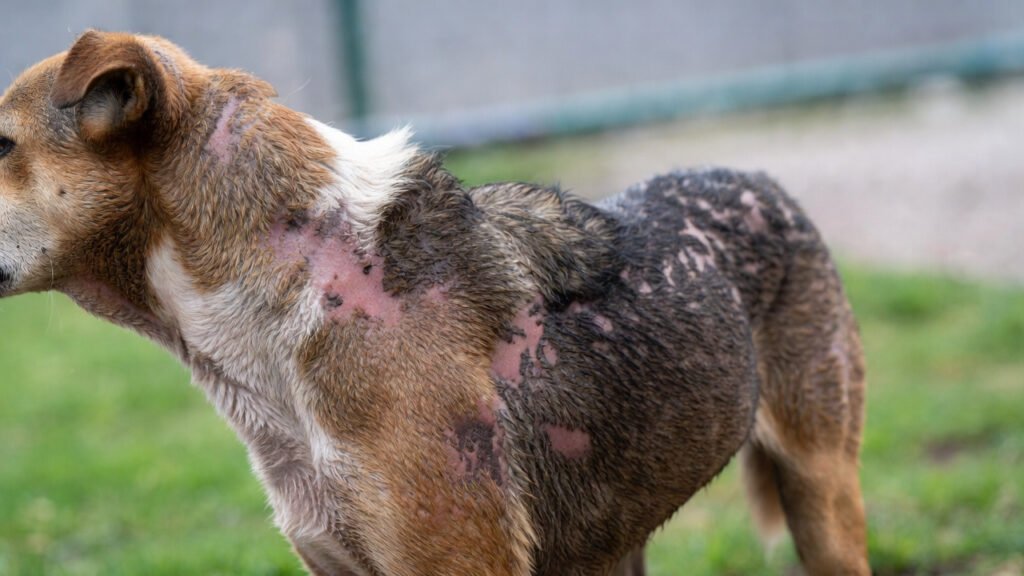
If you have ever been petting your dog and felt a tiny, crusty bump under their fur, you know that immediate spike of anxiety. Your fingers stop, you part the hair, and there it is: a small scabs on dog skin. Is it a tick? Did they get bitten by a spider? Or is this the start of a mysterious skin disease? I have sat with hundreds of pet owners who feel this exact same way. In my years of working with dogs, I’ve learned that while a single scab might be nothing more than a healing scratch from a rogue blackberry bush, a collection of “pimple-sized” dry wounds is usually a message from the skin that something internal or environmental is out of balance.
The short answer is that small scabs on a dog are most commonly caused by one of three things: Flea Allergy Dermatitis (FAD), a secondary bacterial infection like folliculitis, or environmental allergies. However, the way those scabs look—whether they are circular, flaky, red, or crusty—tells a story about the underlying cause. We aren’t just looking at a scab; we are looking at a symptom. In this guide, we are going to dive deep into the world of canine dermatology to help you identify what those spots are, how to provide immediate relief, and when you absolutely need to involve your veterinarian. Let’s decode your dog’s skin together.
Guide Overview:
- 1. Visual Triage: What Do the Scabs Look Like?
- 2. Flea Allergy Dermatitis: The One-Bite Rule
- 3. Bacterial Folliculitis: The “Crusty Circle” Mystery
- 4. Mites and Mange: Sarcoptic vs. Demodectic
- 5. Environmental and Food Allergies: The Itch Cycle
- 6. Bug Bites: Ticks, Spiders, and Flies
- 7. Location Map: Where Are the Scabs?
- 8. At-Home Relief and Skin Support
- 9. Frequently Asked Questions (FAQ)
1. Visual Triage: What Do the Scabs Look Like?
Before we jump into the “why,” we need to look at the “what.” Skin reactions in dogs are diverse. I always ask owners to describe the texture of the small scabs on dog. Is it a “pimple” that popped? Is it a dry, flaky patch? Or is it a hard, dark crust? This visual triage is the first step in our detective work.
If the scab looks like a tiny red dot that has dried into a brown flake, we often lean toward bug bites or fleas. If the scab is surrounded by a ring of peeling skin (which we call an epidermal collarette), that is a classic sign of a bacterial infection. On the other hand, if the skin looks “moth-eaten” with patches of hair loss accompanying the scabs, we start thinking about parasites like mites. By identifying the visual pattern, you can narrow down the list of suspects significantly before your vet visit.
2. Flea Allergy Dermatitis: The One-Bite Rule
You might say, “But I don’t see any fleas!” I hear this every single day. The reality is that for a dog with Flea Allergy Dermatitis (FAD), it only takes one single bite to trigger a systemic reaction. It isn’t the flea itself that causes the scabs; it is an allergic reaction to the flea’s saliva. Think of it as a severe allergic reaction rather than just an infestation.
When a sensitive dog is bitten, their immune system goes into overdrive. This causes intense itching, primarily at the base of the tail, the neck, and the inner thighs. The dog scratches, bites, and licks the area until the skin breaks. Those tiny “pimple-sized” wounds then dry up and form the small scabs on dog you are feeling. Even if your dog is on a preventative, a “breakthrough” bite can happen. If you’ve been seeing these spots for weeks, it’s worth doing a “flea comb” test on a wet white paper towel to look for flea dirt.