My Cat Ate a Hair Tie: Will She Poop It Out? (The Ultimate Survival Guide)

cat ate a hair tie

It starts with a disappearance. You bought a pack of 50 hair ties last month. Today, you can’t find a single one. You check the bathroom counter, the nightstand, and under the sofa cushions. Nothing.

Then, you hear a strange sound coming from the living room. It’s a snap, followed by a gulping noise. You run in just in time to see the tail end of your favorite black elastic band disappearing into your cat’s mouth. You rush forward, trying to gently pry their jaws open, but it’s too late. The gulp is finished. The hair tie is gone.

Your heart drops into your stomach. You freeze. A million questions race through your mind: Will it get stuck? Will it tangle her insides? Do I need to make her vomit? Is this going to cost $5,000 in surgery?

If you are frantically searching “My cat ate a hair tie” at 2:00 AM, take a deep breath. You are not alone. This is, without a doubt, one of the most common emergencies veterinarians see in feline practice. Cats are inexplicably drawn to these stretchy, bouncy, stringy objects.

As a pet care specialist, I have guided hundreds of owners through this exact scenario. Sometimes, it ends with a simple (albeit gross) litter box discovery. Other times, it requires medical intervention.

In this massive, definitive guide, we are going to leave no stone unturned. We will explore the anatomy of a “linear foreign body,” the exact timeline of digestion, how to effectively monitor your cat’s stool, and the critical warning signs that mean you need to rush to the ER immediately.

🧶 The 30-Second Verdict: Will It Pass?

Maybe. But you must be vigilant.

Unlike a smooth marble or a button, a hair tie is dangerous because it is elastic and string-like.

  • Scenario A (The Good News): If it stays bundled in a ball, it *might* pass through the intestines and come out in the poop within 24-48 hours.
  • Scenario B (The Danger): If it unravles or gets hooked on the tongue or stomach exit, it can cause the intestines to “bunch up” like an accordion (Plication). This is fatal without surgery.
  • Immediate Action: Check their mouth. If you see the loop under the tongue, DO NOT PULL IT. Pulling can slice the esophagus. Go to the vet.

The Anatomy of Danger: Why Hair Ties Are Different

To understand the risk when a cat ate a hair tie, you need to understand a bit of veterinary biology. Not all foreign objects are created equal.

If a dog eats a rock, the danger is a simple blockage. The rock gets stuck, nothing moves past it. Simple(ish).

A hair tie, however, falls into a scary category called a Linear Foreign Body.

The “Accordion Effect” (Plication)

Imagine your sweatpants have a drawstring. If you hold one end of the string tight and push the fabric, the fabric bunches up, right?

This is exactly what happens inside a cat. If one end of the hair tie gets snagged (usually at the base of the tongue or the pylorus—the exit of the stomach), the rest of the hair tie trails down into the intestines.

As the intestines try to push the object through (peristalsis), they end up climbing up the hair tie. The intestines bunch up, fold over, and pleat.

Why is this catastrophic?

Because when the intestines bunch up tightly against a thin, taut string (the hair tie), the string acts like a saw. It can saw right through the intestinal wall, causing perforations. This leads to leakage of intestinal contents into the abdomen (Peritonitis), which is rapidly fatal.

This is why we take it so seriously when a cat ate a hair tie. It’s not just a blockage; it’s a potential saw.


The Timeline: How Long Until It Comes Out?

Okay, you understand the risk. Now you want to know how long you have to wait in agony before you know if you are safe.

A cat’s digestive tract is relatively fast.

0 to 2 Hours: The Stomach Phase

Right now, the hair tie is sitting in the stomach. This is the “Golden Window.” If you get to the vet now, they might be able to induce vomiting (more on that later) or retrieve it with an endoscope before it enters the danger zone (the intestines).

2 to 10 Hours: The Small Intestine

The stomach empties its contents into the small intestine. This is the longest and narrowest part of the journey. This is where blockages or plication usually happen. If the hair tie is going to get stuck, it will likely happen here.

10 to 24 Hours: The Large Intestine

If the hair tie makes it this far, celebrate! The large intestine (colon) is much wider. Blockages here are rare. The body is now prepping to expel the object.

24 to 48 Hours: The “Poop” Window

Most foreign objects that are going to pass will appear in the litter box within 24 to 48 hours.

The Rule of Thumb: If 48 hours have passed and you haven’t seen the hair tie, AND your cat is acting normal, it is possible it’s still in the stomach (some objects float around there for weeks) or you missed it. If they are acting sick, it is definitely stuck.


Symptoms of a Blockage: Red Flags vs. Yellow Flags

You’ve decided to take the “Wait and See” approach. You need to watch your cat like a hawk. What exactly are you looking for?

🚨 RED FLAGS (Go to ER Now)

If you see ANY of these signs after your cat ate a hair tie, do not wait for the morning. Go to the emergency vet.

  1. Projectile Vomiting: Not just a little hairball. I mean repetitive, forceful vomiting. Especially if they vomit liquid or food immediately after eating.
  2. Vomiting Fecal Material: If the vomit smells like poop, it means the blockage is low down and things are backing up. This is critical.
  3. Lethargy/Hiding: If your usually active cat is curled up in a closet, refusing to look at you, or sleeping in the litter box (as we discussed in our Health Section), they are in pain.
  4. Painful Abdomen: If you touch their belly and they growl, hiss, or tense up.
  5. Straining to Poop: Going to the box, pushing, and nothing coming out.

⚠️ YELLOW FLAGS (Monitor Closely)

  • Loss of Appetite: They sniff food but walk away.
  • Lip Licking: A sign of nausea.
  • Reduced Poop: Smaller than normal clumps.

Worried owner checking cat who ate a hair tie


The “Wait and See” Protocol: How to Check the Poop

If your cat is acting 100% normal—eating, playing, purring—you can monitor them at home. But this requires some dedication. You are going to become a “Poop Detective.”

The Dissection Method

You cannot just glance at the litter box. Hair ties can be coated in fecal matter and litter, making them look just like… well, poop.

  1. Get Tools: Buy a box of disposable gloves and some wooden popsicle sticks (or plastic forks).
  2. Collect: Every time your cat uses the box, scoop the deposit immediately.
  3. Dissect: Put the poop on a paper plate or paper towel. Use the sticks to break it apart completely. You are looking for the elastic band.
  4. Verify: If you find it, wash it off (gross, I know) to confirm it is the whole hair tie and not just a piece.

Should I Feed Them Something Special?

Some vets recommend feeding a high-fiber meal to help “cushion” the object and push it through.
Tip: You can add a teaspoon of plain canned pumpkin (not pie filling) to their wet food. This adds bulk to the stool and can help speed up transit time safely.

WARNING: Do NOT give laxatives or mineral oil. This can cause diarrhea, dehydration, and aspiration pneumonia if forced down.


Medical Interventions: What Can the Vet Do?

Let’s say it’s been 3 hours and you are worried, or your cat started vomiting. What happens when you walk into the clinic?

1. Inducing Vomiting (The Controversy)

With dogs, if they eat something bad, we almost always make them vomit. With cats, it is much harder.

  • The Risk: Common emetics (vomit-inducing drugs) like Hydrogen Peroxide often cause severe gastritis and bleeding ulcers in cats. NEVER give peroxide to a cat at home.
  • The Vet Drug: Vets use a drug called Xylazine or Dexmedetomidine. It works about 60% of the time.
  • The Danger: If the hair tie is already halfway into the intestine, trying to vomit it up can pull the intestine tight (remember the drawstring analogy), causing immediate damage. Most vets will NOT induce vomiting if it has been more than 2-3 hours.

2. Diagnostics (X-Rays and Ultrasound)

Here is the tricky part: Hair ties do not show up on X-rays. Unlike metal or bone, rubber is “radiolucent” (invisible to radiation).

So why do vets take X-rays? They look for “gas patterns.” If the intestines look like a string of pearls (gas bubbles trapped in bunched-up loops), that indicates a linear foreign body. Ultrasound is even better at seeing the bunched-up intestine.

3. Endoscopy

If the hair tie is still in the stomach, a specialist can put a long camera down the throat and grab the hair tie with a tiny claw. This is non-surgical and recovery is instant. However, it is expensive and requires anesthesia.

4. Surgery (Exploratory Laparotomy)

If the blockage is confirmed, surgery is the only option. The vet will open the abdomen, locate the blockage, cut open the intestine (enterotomy), remove the hair tie, and stitch it back up. If the tissue is dead (necrosis), they may have to remove a section of the intestine (resection and anastomosis).

The Cost of Surgery 💸

I want to be realistic with you. Foreign body surgery is major abdominal surgery. Depending on where you live and if it is an emergency clinic or a regular vet:

  • Regular Vet: $1,500 – $3,000
  • Emergency Specialist: $3,000 – $6,000+

This is why pet insurance is a lifesaver for cat owners. (For more on safety costs, see our Safety Center).


The Psychology: Why Do Cats Eat Hair Ties?

Why do they do this? Are they hungry? Stupid? No. It’s usually biological or psychological.

1. Prey Drive Stimulation

A hair tie moves unpredictably. When you flick it, it flies across the room like a bug. When it lands, it looks like a small worm or snake. Your cat’s hunting instinct kicks in. They catch it, bite it to “kill” it, and the texture feels satisfying.

2. Pica (The Urge to Eat Non-Foods)

Pica is a condition where cats crave non-food items. This can be caused by:

  • Dietary Deficiencies: Lack of fiber or fat.
  • Anemia: Low iron.
  • Boredom: Indoor cats with nothing to do need oral stimulation.
  • Early Weaning: Cats taken from their mothers too young often suckle on wool or fabric (wool sucking), which transitions to chewing elastic.

3. Scent

Hair ties smell like you. They are covered in your hair products, sweat, and pheromones. To a cat, eating something that smells like their favorite person is a weird form of bonding.

Cat playing with hair tie showing prey drive


Prevention: How to Cat-Proof Your Life

Once a cat develops a taste for hair ties, they will never stop. You cannot “train” this out of them. You must manage the environment.

1. The “Drawer Rule”

Hair ties simply cannot exist on surfaces. They must live in a closed drawer or a jar with a screw-top lid. If you take one out of your hair, it goes immediately into the jar or the trash. Never on the nightstand.

2. Switch Your Elastics

Consider using scrunchies. They are large, fabric-covered, and much harder to swallow. Most cats will bat a scrunchie around but won’t try to eat it because it’s too big to gulp.

3. Enrichment

If your cat is bored, give them safe alternatives. Food puzzles, lick mats, and cat grass can satisfy the urge to chew and hunt without the $5,000 surgery risk.


Frequently Asked Questions (FAQ)

Q: My cat ate half a hair tie. Is that better?
A: Slightly, yes. A smaller piece is less likely to cause the “accordion” plication effect because it isn’t long enough to anchor in the stomach and reach the intestine at the same time. However, it can still cause a simple blockage. Monitor closely.

Q: I see the hair tie sticking out of my cat’s butt. Should I pull it?
A: NO! NEVER! I cannot scream this loud enough. If you see a string hanging from the anus, do not pull it. If the other end is tangled deep inside the intestine, pulling it acts like a cheese wire and can slice through the intestine, causing fatal sepsis. Trim the excess with scissors and let them pass the rest naturally, or go to the vet.

Q: Can I give Vaseline to help it pass?
A: No. Vaseline (petroleum jelly) is not digestible, but in large amounts, it interferes with nutrient absorption and can cause vomiting. Stick to plain pumpkin or vet-prescribed laxatives (like Laxatone) if instructed.

Q: Are rubber bands worse than fabric hair ties?
A: They are equally dangerous, but rubber bands are “grippier.” They create more friction against the intestinal wall, making them harder to pass. Fabric hair ties are slightly smoother but pose the same linear body risk.

Final Thoughts

Realizing your cat ate a hair tie is a sickening feeling. I have seen many owners beat themselves up over it. “I left it on the counter for one second!”

Please, be kind to yourself. Cats are fast, stealthy, and incredibly persistent. The important thing is what you do now.

If it just happened, call your vet. If it’s been a day, start your poop patrol. And going forward, treat hair ties like hazardous waste. Lock them up, switch to scrunchies, and give your little hunter safer toys to destroy.

For more detailed guides on household toxins and dangers, verify your home safety with our Toxic Foods & Items list.


Help! My Dog Ate a Bee : Signs of Sting & What to Do Fast

dog ate a bee

We have all seen the photos on social media. A dog with a comically swollen snout, looking like a cartoon character, with a caption like “He ate a spicy sky raisin.”

While these photos might get a chuckle, when it happens to your dog, it is terrifying. You are in the garden, you see them snap at something buzzing in the air, and suddenly there is yelping, whining, and frantic pawing at the mouth.

The realization hits you: My dog ate a bee.

Panic sets in. Will his throat close up? Is he allergic? What if he swallowed the stinger?

As a pet safety expert, I want you to take a deep breath. While bee stings can be serious, the vast majority of dogs recover with just a little swelling and some extra cuddles. However, because the sting is inside the mouth or throat, you need to act faster than if they had just stepped on one.

In this emergency guide, we will walk through the immediate triage steps. We will learn how to spot the signs of a life-threatening allergic reaction, how to safely remove a stinger from a squirming dog’s tongue, and when you can handle it at home versus when to rush to the ER.

🐝 Emergency Action Plan: 5-Minute Checklist

If you just saw your dog ate a bee, do this now:

  1. Check the Airway: Open their mouth. Is the tongue or throat swelling rapidly? If they are wheezing, go to the vet NOW.
  2. Find the Stinger: If you see a black barb, scrape it out with a credit card. DO NOT pinch it with tweezers (this squeezes more venom in).
  3. Ice It: Offer ice water or hold an ice pack to the snout to reduce swelling.
  4. Call the Vet: Ask about giving Benadryl (Diphenhydramine). Do not guess the dose.
  5. Monitor: Watch them like a hawk for the next 30 minutes for allergic reactions.

1. The “Spicy Sky Raisin”: What Actually Happens?

Dogs explore the world with their mouths. A buzzing bee looks like a fun, interactive toy. When your dog ate a bee (or a wasp), the insect usually stings them in one of three places: the lips, the tongue, or the back of the throat.

The Venom: Bee venom causes localized pain and an immediate histamine reaction. This means fluids rush to the area, causing that classic “puffy face” look.

Bee vs. Wasp:

  • Bees: Leave their stinger behind (it keeps pumping venom). They die after stinging.
  • Wasps/Hornets: Do not leave a stinger. They can sting multiple times.

2. Signs Your Dog Was Stung (If You Didn’t See It)

Sometimes you don’t see the event, you just see the aftermath. How do you know if your **dog ate a bee** or if they just hurt a tooth?

Look for these classic symptoms:

  • Sudden Yelping: Running around the garden crying for “no reason.”
  • Frenzied Pawing: Trying to scratch their mouth or tongue.
  • Excessive Drooling: More than normal slobber.
  • Swelling: The muzzle, lips, or eyelids might puff up within minutes.
  • Hives: Bumps appearing on the body (look at the belly where fur is thin).

dog ate a bee

3. The Danger Zone: Anaphylactic Shock

This is the scary part. Just like humans, some dogs are highly allergic to bee stings. If your dog goes into anaphylactic shock, their airway can close, or their blood pressure can drop dangerously low.

If you see ANY of these signs, drive to the Vet immediately:

  • Pale Gums: Lift the lip. If gums are white or blue (instead of pink), they lack oxygen.
  • Collapse: Sudden weakness or fainting.
  • Vomiting/Diarrhea: Severe vomiting within 5-10 minutes of the sting.
  • Respiratory Distress: Loud, raspy breathing or gasping for air.

4. Home Treatment: How to Help Them Heal

If your dog is breathing fine but just looks swollen and miserable because your **dog ate a bee**, you can treat them at home.

Step 1: Remove the Stinger (The Credit Card Trick)

If the sting is on the lip or visible on the tongue, look for a tiny black dot.

Technique: Take a credit card or a stiff piece of cardboard and scrape it across the skin to pop the stinger out.

Warning: Never use tweezers or your fingers to pinch it. The venom sack is usually still attached. Pinching it injects the remaining venom into your dog.

Step 2: The Power of Ice

Swelling is the enemy.

  • External: Wrap an ice pack in a towel and hold it to their swollen muzzle for 10 minutes.
  • Internal: If the sting is inside the mouth, give them ice cubes to crunch on or ice water to drink. The cold helps numb the tongue and reduce throat swelling.

Step 3: Baking Soda Paste

If the sting is on the outside (lip or nose), mix baking soda with a little water to make a thick paste. Apply it to the sting site. It helps neutralize the acidic venom and reduces pain.

5. Can I Give My Dog Benadryl?

Yes, Diphenhydramine (Benadryl) is commonly used by vets for bee stings. It is an antihistamine that reduces swelling and itching.

However, you must be careful:

  1. Check Ingredients: Only use plain Diphenhydramine. NEVER use “Cold & Sinus” versions or liquid Benadryl containing Xylitol (which is toxic).
  2. The Dosage: The standard rule of thumb is 1 mg per pound of body weight. (Example: A 25lb dog gets one 25mg tablet).

(Please verify the correct dosage for your pet’s size on the AKC Benadryl Dosage Chart before administering).

Dog resting after medical treatment

When is “Eating a Bee” Fatal?

I don’t want to scare you, but you need to know the risks. A **dog ate a bee** situation becomes fatal if:

  1. Multiple Stings: They disturbed a nest and swallowed 5 or 6 bees. The toxin load is too high for their kidneys.
  2. Throat Swelling: The sting was deep in the throat, causing swelling that blocks the windpipe (asphyxiation).
  3. Delayed Reaction: Sometimes the crash happens 20 minutes later. Keep watching them.

Frequently Asked Questions (FAQ)

Q: Will my dog learn a lesson?
A: Sadly, probably not. Many dogs find “sky raisins” (bees) and “spicy flies” (wasps) fascinating. The prey drive often overrides the memory of the pain. You will need to supervise them.

Q: Can I use an EpiPen on my dog?
A: NO. Human EpiPens deliver a dose designed for a 150lb human. This could cause a heart attack in a dog. Only a vet can administer epinephrine safely.

Q: What if the swelling doesn’t go down?
A: Benadryl usually works within 30-60 minutes. If the face is still getting bigger after an hour, or if the swelling lasts more than 24 hours, go to the vet. They may need a steroid shot.

Final Thoughts

Finding out your dog ate a bee is a stressful rite of passage. The swelling looks dramatic, and the whining breaks your heart. But remember: dogs are resilient.

Most of the time, with a little ice, a little antihistamine, and a lot of sympathy, they will be back to chasing squirrels (and hopefully avoiding bees) by tomorrow. Keep your first aid kit ready, stay calm, and you will get through this.

For more life-saving advice, make sure to bookmark our Emergency First Aid section.

My Dog ate silica gel packet: Everything You Need to Know and Do Right Now

My Dog ate silica gel packet: Everything You Need to Know and Do Right Now

I have been through this scenario dozens of times with worried pet owners. You open a new pair of shoes, a leather handbag, or a bag of beef jerky, and before you can toss the packaging, your dog has snatched that little white packet. The “DO NOT EAT” warning in bold letters is enough to send any dog parent into a full-blown panic. I want you to take a deep breath right now. In the vast majority of cases, your dog is going to be perfectly fine. Silica gel itself is not actually a poison; it is a desiccant designed simply to keep things dry. However, while the beads inside aren’t toxic in the traditional sense, the packet itself and the way the gel interacts with your dog’s body can cause issues. We need to look at the size of your dog, the type of packet they swallowed, and what symptoms you should watch for over the next 24 to 48 hours. Let’s walk through the reality of silica gel ingestion so you can stop worrying and start taking the right steps for your pet’s health.

What Exactly Is Silica Gel?

To understand why these packets aren’t usually a death sentence, we have to look at what’s inside them. Silica gel is a form of silicon dioxide. If that sounds like a chemical mouthful, think of it more simply: it’s essentially a highly porous, synthetic version of sand. Its primary job is to pull moisture out of the air to prevent mold, mildew, and spoilage in consumer products.

When you touch these beads, they feel like hard, clear, or white little pebbles. They don’t dissolve in water like sugar or salt. Instead, they act like a tiny sponge. Because they are chemically inert, they don’t react with the body’s systems or get absorbed into the bloodstream. This is the main reason why they aren’t considered a “poison” by toxicology standards.

Most of the packets we find in shoeboxes or electronics contain about 1 to 5 grams of these beads. In the world of veterinary medicine, that is a very small amount of material. Even for a small dog, the chemical makeup of the silica isn’t the primary concern. Have you noticed how these packets are everywhere lately? From vitamin bottles to new coats, they are a staple of modern shipping, which unfortunately makes them a staple of “items dogs shouldn’t eat.” For a broader look at safety, check our comprehensive pet care guides.

Silica gel beads spilled from packet
The beads inside a silica gel packet are essentially a synthetic, highly absorbent form of sand.

Is Silica Gel Toxic to Dogs? Understanding the Biology

The short answer is no. If your dog just ate the beads themselves, they will likely pass through the digestive tract completely unchanged. Since the body doesn’t break down silicon dioxide, it doesn’t enter the metabolic system. You might even see the little beads in your dog’s stool tomorrow morning, looking exactly like they did when they went in.

So, why the scary “Do Not Eat” labels? Those warnings are primarily there for humans, particularly children. In humans, these packets are a significant choking hazard. Additionally, because the beads are designed to absorb moisture, they can cause intense dryness in the mouth, throat, and stomach if consumed in massive quantities. But a single packet? It’s not enough to cause chemical harm.

For a dog, the main “toxic” risk only appears if the silica gel has been used in an industrial setting where it might have absorbed harmful chemicals. However, the packets found in consumer goods are almost always “food grade” or “retail grade,” meaning they are clean of outside contaminants. If you are ever unsure about what your dog can and cannot eat, it is helpful to review a list of common household items toxic to dogs to keep your home safe.

The Real Danger: Intestinal Blockage and Choking Hazards

When a dog eats a silica packet, I am much more worried about the “packet” part than the “gel” part. The beads are usually contained in a small pouch made of paper or Tyvek, which is a heavy-duty plastic-like fabric. This material is designed to be tough and moisture-resistant, which means it doesn’t break down easily in the stomach.

Choking Hazards

If your dog is a “gulper,” they might try to swallow the packet whole. This can lead to the packet getting lodged in the esophagus. If you notice your dog gagging, pawing at their mouth, or struggling to breathe immediately after they’ve scavenged a packet, this is a medical emergency.

Foreign Body Obstruction

This is the most common serious complication. The packet, especially if it’s one of the larger ones found in gym bags or electronics, can get stuck in the pylorus (the exit of the stomach) or further down in the narrow passages of the small intestine. Once a blockage occurs, nothing can move through the digestive tract. It’s a scary scenario, but it is much more likely to happen with small breeds eating large packets. Join our Pet Care Community on Facebook for more emergency safety discussions.

Dog being examined at a vet
If your dog swallows a large packet whole, an internal blockage becomes the primary concern.

Silica Gel vs. Oxygen Absorbers: A Critical Distinction

This is a point where I see a lot of confusion, and it is the most important part of this article. Not every small packet found in a bag of food is silica gel. Oxygen absorbers are often found in bags of beef jerky, pepperoni, or birdseed. Unlike silica gel, which contains clear beads, oxygen absorbers contain iron powder.

When a dog eats an oxygen absorber, it can lead to iron poisoning. Iron is highly toxic to dogs in large amounts and can cause severe damage to the liver and digestive lining. From what many owners notice, dogs are much more likely to eat the oxygen absorbers in jerky bags because the packet itself smells like the meat it was protecting.

  • Silica Gel: Usually says “Silica Gel” and contains clear/white beads.
  • Oxygen Absorber: Often says “Oxygen Absorber” or “Iron Powder” and contains a dark, fine powder that might stick to a magnet.

If you suspect your dog ate an oxygen absorber rather than silica gel, you should call your vet or a pet poison control center immediately. For more daily tips on identifying hazards, follow our Facebook page where we share real-time advice for pet parents.

Immediate Steps to Take After Your Dog Swallows a Packet

If you just caught your dog with an empty or torn packet, don’t scream or chase them. This often causes dogs to swallow the evidence even faster out of “resource guarding” or fear. Instead, follow these steps:

  1. Secure the Dog: Move them away from the area so they don’t eat any more packets.
  2. Identify the Packet: Find the remains. Does it say “Silica Gel”? Is it torn open?
  3. Check the Mouth: If they just put it in their mouth, gently sweep it out. If they’ve already swallowed, don’t try to reach down their throat.
  4. Offer Water: Offering a fresh bowl of water can help with the dryness and irritation caused by the desiccant.
  5. Check for Choking: Observe their breathing carefully.

Should you induce vomiting? I strongly advise against inducing vomiting at home unless specifically instructed to do so by a licensed veterinarian. If your pet’s stomach seems a bit off after the ordeal, you can learn how to settle a dog’s upset stomach using safe methods.

Dog resting on rug
After swallowing a packet, keep your dog calm and monitor them for the next 48 hours.

Symptoms of Complications: What to Monitor Over 48 Hours

In most cases, you will be in “observation mode” for the next 48 hours. Most packets pass through a dog’s system within 24 to 72 hours. You should be looking for any signs that the packet has caused a physical blockage or significant irritation.

Monitor for repeated vomiting, lethargy, or loss of appetite. If they turn their nose up at dinner, it’s a red flag. Also, look for signs of abdominal pain—does your dog hunch their back or whine when you touch their belly? I’ve found that many owners underestimate how long it takes for things to pass in older dogs. Their systems don’t always run like clockwork, so that window might be slightly longer. Find more health tracking tips at petscatsdogs.com.

The Hidden Risk of Indicator Beads (Blue or Pink Silica)

While standard clear silica gel is non-toxic, you might occasionally see beads that are bright blue or pink. These are “indicating” silica gels. They change color when they have reached their maximum moisture-holding capacity. The blue beads often contain a small amount of cobalt chloride, which is considered toxic. If your dog has consumed the blue variety, it is worth a phone call to a pet poison hotline to calculate the risk based on your dog’s weight.

When to Call the Emergency Vet Immediately

You know your dog better than anyone else. Trust your gut. However, there are times when a vet visit is mandatory: if a small breed swallowed a large packet whole, if your dog has a known history of blockages, or if you confirmed the packet contained iron powder. At the vet’s office, they might perform an X-ray to look for signs of an obstructed bowel. Always have the phone number of your local emergency veterinarian saved in your phone.

The Role of Dog Size and Health History

Does dog size matter? It certainly does. If a 100-pound Labrador eats a 1-gram packet, it’s like a human swallowing a grain of rice. However, if a 4-pound Chihuahua swallows that same packet, we have to be much more concerned about the physical size of the packet. Younger puppies and senior dogs with slower motility should also be watched more closely.

Dog bowl and alarm clock
The time it takes for a packet to pass depends heavily on your dog’s size and digestive health.

Training and Prevention: How to Stop Future Accidents

The best way to handle a silica gel scare is to prevent it from happening again. Dogs are natural scavengers. Always do a “new item sweep” when you buy shoes or handbags. Hunter for the packet immediately and throw it in a lidded trash can. Training a solid “Leave It” command is also life-saving.

So how do you know if your dog is learning correctly? Consistency is the key. Practice the command in different environments. If your dog can leave a piece of jerky on the floor, they can learn to leave a silica packet. Check our training guides for more advanced techniques. You can also see video demonstrations of these commands on our Facebook community page.

Frequently Asked Questions

How long does it take for a dog to pass a silica packet?

Most objects pass within 24 to 72 hours. If you haven’t seen it after three days and they are acting normally, they may have chewed it into tiny pieces.

Will the packet dissolve in the stomach?

No. Both the beads and the Tyvek/paper packets are designed to withstand moisture and will stay intact throughout the digestive tract.

Should I feed my dog bread to help the packet pass?

Some vets recommend a slice of plain white bread or a tablespoon of plain canned pumpkin to help “cushion” the object, but check with your vet first.

My dog ate the beads but not the packet. Is that better?

Generally, yes. The beads are small and will pass easily. The packet is what usually causes the physical blockage.

Are jerky packets more dangerous?

They are often oxygen absorbers (iron powder) rather than silica gel, making them much more toxic if ingested.

Final Thoughts for Concerned Dog Parents

It is natural to feel panic when your dog eats something they shouldn’t. But with silica gel, a calm owner who monitors their pet is the best asset. Most of the time, this will end up being a “poop-watching” mission for a couple of days. Realize that while the warning says “Do Not Eat,” it’s usually not a death sentence for a dog. Keep an eye on that tail wag, keep the water bowl full, and trust the process. For more resources and community support, keep following our updates at petscatsdogs.com. Your dog’s health is our top priority!


Help! My Dog Ate Chocolate: 5 Emergency Steps & Toxicity Timeline

Help! My Dog Ate Chocolate: 5 Emergency Steps & Toxicity Timeline

Help! My Dog Ate Chocolate It is the moment every dog owner dreads.

I walked into the kitchen after a long day at the clinic, expecting to be greeted by a wagging tail. Instead, I was greeted by the rustling sound of a wrapper and a guilty look. On the floor lay the shredded remains of a dark chocolate bar I had been saving for myself. My Golden Retriever, Bailey, sat there licking his lips, looking remarkably proud of his “hunt.”

My heart sank. Even as a veterinarian, that initial wave of panic hit me hard. How much did he eat? What kind was it? How long ago did this happen?

If you are reading this right now, your heart is probably racing just like mine was. You are likely staring at an empty candy wrapper and a very satisfied-looking pup, wondering if you need to rush to the emergency room.

Take a deep breath. You are in the right place.

While chocolate toxicity is serious, it is also treatable if caught early. In this comprehensive guide, we will move past the panic. I will walk you through exactly why dog ate chocolate scenarios happen, how to calculate the danger level, the symptom timeline you need to watch for, and the immediate steps you must take to keep your best friend safe.

The Quick Answer: What Should I Do Right Now?

If you just caught your dog in the act, do not wait for symptoms to appear. Time is of the essence.

🚨 Emergency Action Plan:

  1. Stop them: Remove any remaining chocolate from their reach immediately.

  2. Identify: Find the wrapper. Check the type (Dark, Milk, White) and the weight (how many grams/ounces?).

  3. Calculate: A 50lb dog eating one milk chocolate bar is usually fine. A 10lb dog eating dark chocolate is in critical danger.

  4. Call the Vet: If you suspect they ate a toxic amount, call your vet or the ASPCA Poison Control Center (888-426-4435) immediately.

  5. Do NOT induce vomiting unless a professional tells you to. Some dogs can aspirate vomit into their lungs.


The Science: Why Is Chocolate Toxic to Dogs?

To understand the urgency when a dog ate chocolate, we need to look at the chemistry. We humans love chocolate because it gives us a little boost of energy and happiness. That boost comes from a compound called Theobromine (and to a lesser extent, Caffeine).

Human bodies process theobromine quickly and easily. Dogs, however, do not.

When a dog ingests chocolate, the theobromine stays in their system for a very long time (up to 72 hours). It acts as a powerful stimulant, affecting their:

  • Central Nervous System (causing tremors and seizures).

  • Cardiovascular System (causing racing heart rates and arrhythmias).

  • Kidneys (causing excessive urination).

It’s Not Just About the Sugar

Many owners think the sugar is the problem. While sugar isn’t good for them, the real killer is the theobromine. This is why the type of chocolate matters more than the amount.


The Danger Scale: Not All Chocolate is Created Equal

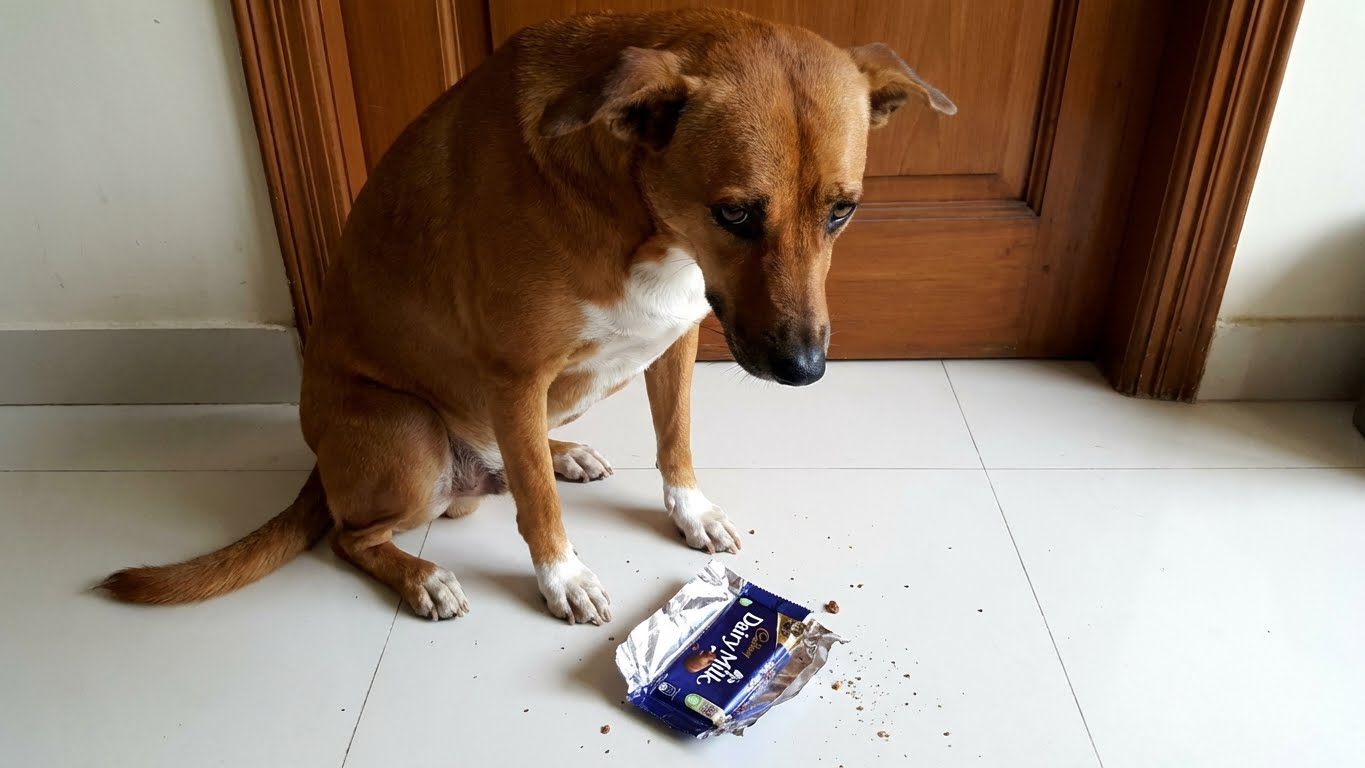
Dog ate chocolate wrapper.

This is the most critical section of this guide. If you are panicking because your dog ate chocolate, you need to know what kind. The darker and more bitter the chocolate, the more dangerous it is.

1. White Chocolate (Low Risk)

  • Theobromine Content: Negligible.

  • The Verdict: If your dog ate white chocolate, they are unlikely to suffer from chocolate poisoning. However, the high fat and sugar content can still cause Pancreatitis (severe inflammation of the pancreas) or an upset stomach. Expect vomiting and diarrhea, but likely no seizures.

2. Milk Chocolate (Moderate Risk)

  • Theobromine Content: ~44-58 mg per ounce.

  • The Verdict: Dangerous for small dogs or in large quantities. A Great Dane eating one M&M is fine. A Chihuahua eating a whole Hershey’s bar is an emergency.

3. Dark / Semi-Sweet Chocolate (High Risk) ⚠️

  • Theobromine Content: ~150 mg per ounce.

  • The Verdict: This is serious. Even small amounts can cause toxicity in medium-sized dogs. If your dog ate chocolate labeled “Dark” or “50% Cocoa,” call the vet immediately.

4. Baking Chocolate / Cocoa Powder (Critical Emergency) ☠️

  • Theobromine Content: ~400 mg per ounce.

  • The Verdict: This is highly concentrated. A very small amount (just a few spoonfuls of cocoa powder) can be lethal to a dog. This is a “drive to the vet now” situation.


The Symptom Timeline: What to Watch For

If you didn’t catch your dog in the act, or if you are “waiting and seeing” (which I generally advise against for dark chocolate), you need to know the timeline. Symptoms don’t appear instantly; they progress as the toxin absorbs.

Stage 1: The First 0–2 Hours (Early Signs)

As the chocolate hits the stomach, the body tries to reject it.

  • Vomiting: Often smells like chocolate.

  • Diarrhea: May be loose or uncontrollable.

  • Hyperactivity: Your dog might seem “caffeinated.” Pacing, panting, and unable to settle.

  • Excessive Thirst: Drinking water bowl after water bowl.

Stage 2: 2–4 Hours (Cardiac Issues)

As the theobromine enters the bloodstream, it hits the heart.

  • Racing Heart Rate: You might feel their heart pounding through their chest.

  • Restlessness: Why is my dog ate chocolate symptom list including pacing? Because their heart feels like it’s exploding.

  • Muscle Tremors: Shaking or shivering (not from cold).

Stage 3: 12–24 Hours (Severe Toxicity)

If left untreated, the toxins attack the nervous system and kidneys.

  • Seizures: Full body convulsions.

  • Collapse: Inability to stand.

  • Coma: In severe cases, this can lead to heart failure.

Note: The half-life of theobromine is long. Symptoms can last for days, and the toxin can be re-absorbed from the bladder, which is why frequent potty breaks are essential.


5 Emergency Steps to Take Immediately

Dog ate chocolate wrapper

You’ve confirmed it: your dog ate chocolate, and it was a dangerous amount. Here is your step-by-step action plan.

Step 1: Secure the Dog and the Evidence

Remove the remaining chocolate immediately. Dogs will often keep eating even if they are already feeling sick. Put the rest in a high cupboard or a locked trash can.
Do not throw away the wrapper. You will need it to tell the vet the exact cocoa percentage.

Step 2: Perform the “Math”

Estimate how much they ate.

  • Did they eat the whole bar or just half?

  • Was it a 100g bar or a “Fun Size”?
    Be honest. It is better to overestimate than underestimate.

Step 3: Call the Professionals

Do not rely on Facebook groups for this. Call your veterinarian or an emergency animal hospital.
You can also use the ASPCA Poison Control Center. They charge a fee, but their toxicologists can tell you exactly if the dose was lethal based on your dog’s weight.

Step 4: Induce Vomiting (ONLY if Instructed)

Warning: Never do this without vet approval.
If the ingestion happened within the last hour, your vet might tell you to induce vomiting using 3% Hydrogen Peroxide.

  • The Dose: Usually 1 teaspoon per 5-10 lbs of body weight.

  • The Method: Squirt it into the back of their mouth with a syringe or turkey baster.

  • The Risk: If your dog is already lethargic or having tremors, inducing vomiting can cause them to inhale the vomit, leading to aspiration pneumonia. Never force a seizing dog to vomit.

Step 5: Head to the Vet

If the dose is high, home remedies aren’t enough. Your dog needs IV fluids and Activated Charcoal.


What Happens at the Vet? (Don’t Be Scared)

Many owners hesitate to go to the vet because they are afraid of the cost or the procedure. Let me demystify it for you so you know what to expect.

When you arrive with a dog ate chocolate case:

  1. Decontamination: If they haven’t vomited yet, the vet will give them an injection (like Apomorphine) which works instantly and is safer than hydrogen peroxide.

  2. Activated Charcoal: This is a black liquid that acts like a magnet. It binds to the toxins in the stomach and intestines, preventing them from entering the bloodstream. Your dog will drink this (or be fed via a tube).

  3. IV Fluids: This is crucial. Fluids flush the kidneys and help push the toxins out of the body faster through urine.

  4. Heart Monitoring: An ECG might be hooked up to watch for irregular heartbeats.

Most dogs who receive treatment within 2-4 hours make a full recovery and are back to their happy selves within a day.


Hidden Sources of Chocolate: It’s Not Just Candy Bars

We often think of candy bars, but chocolate lurks in places you might not expect. As a vet, I have seen toxicity cases from:

  • Protein Bars & Shakes: Often contain high amounts of cocoa powder.

  • Cocoa Mulch: Some gardening mulch is made from cocoa bean shells. It smells delicious to dogs but is incredibly toxic.

  • Baked Goods: Brownies and chocolate cake are double trouble (chocolate + high fat).

  • Espresso Beans: Chocolate-covered coffee beans are a “double whammy” of caffeine and theobromine.


Prevention: How to “Chocolate-Proof” Your Home

We can’t watch our dogs 24/7. Bailey ate my chocolate because I left it on the counter for just a minute. To prevent a future dog ate chocolate scare:

  1. The “Counter Surfing” Rule: Never leave food on low counters or coffee tables. Dogs are opportunists.

  2. Secure the Trash: Use a trash can with a locking lid or keep it in a cupboard.

  3. Teach “Leave It”: This is the most valuable command a dog can learn. It can literally save their life if they drop something toxic on the floor.
    (Check out our guide on [Puppy Training and Obedience] to master this command).

  4. Educate Guests: During holidays like Easter or Halloween, remind guests not to leave candy bags on the floor or sofas.


Frequently Asked Questions (FAQ)

Q: My dog ate one M&M. Will he die?
No. One M&M contains a tiny amount of chocolate. Unless your dog weighs 1 pound, they will be fine. Monitor for an upset stomach, but panic is unnecessary.

Q: Can I give my dog milk to help flush out the poison?
No. Milk does not neutralize chocolate. In fact, dairy can cause more diarrhea and vomiting, making dehydration worse. Stick to water.

Q: How long does it take for chocolate to leave a dog’s system?
Theobromine has a long half-life. It can take up to 72 hours (3 days) to completely leave their body. This is why symptoms can linger or reappear if the dog re-absorbs toxins from their bladder.

Q: Why can humans eat chocolate but dogs can’t?
It comes down to liver enzymes. Humans have enzymes that break down theobromine very fast. Dogs lack these specific enzymes, so the toxin builds up to dangerous levels instead of being digested.

Q: My dog ate chocolate yesterday and seems fine. Am I in the clear?
Not necessarily. While the acute danger phase (heart attack) might have passed, kidney damage can be silent. It is always worth a vet checkup for blood work just to be safe.


Final Thoughts: Don’t Beat Yourself Up

If you are reading this while sitting in the waiting room of an emergency vet, please stop blaming yourself.
Accidents happen. Dogs are fast, clever, and driven by their noses. I am a vet, and it happened to me with Bailey.

The important thing is that you are taking action. By understanding the risks when a dog ate chocolate and acting quickly, you are giving your pet the best chance of survival.

Most dogs bounce back quickly with the right care. So, take a deep breath, trust your vet, and maybe switch to vanilla cake for a while!

For more urgent safety tips, bookmark our [Safety Center] category to keep your furry family safe from household hazards.