
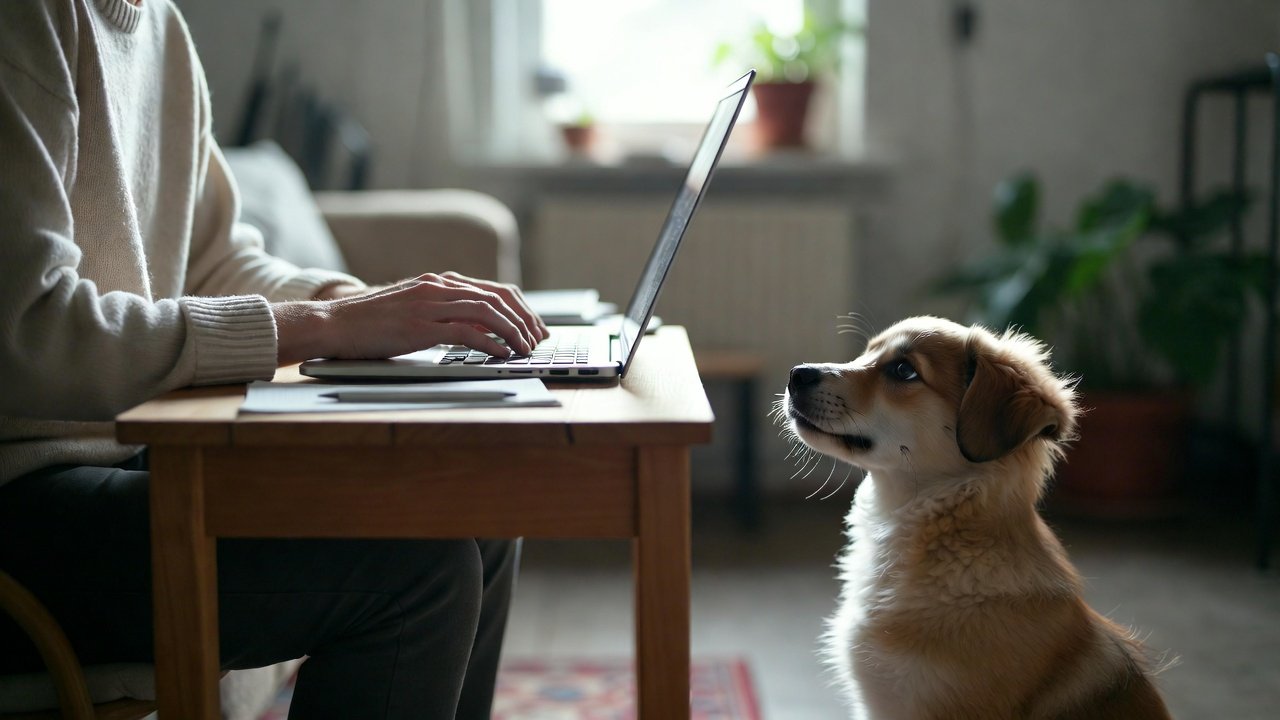
Raising a young dog while keeping up with a full-time job is a unique form of chaos that only a few brave souls truly understand. If you’ve been wondering how to work from home with a puppy without losing your mind—or your job—you’re in the right place. I remember my very first attempt at this balance; I was in the middle of a high-stakes consulting call when my 11-week-old puppy decided that my internet cable looked like a delicious chew toy. It was a stressful world of frantic “mute” buttons and constant distractions.
The hard truth is that you cannot simply “wing it.” If you try to let your puppy roam free while you attend Zoom meetings, you will fail at both being a professional and being a pet parent. Success requires a strategic rhythm that mimics their natural biological needs. This guide is a battle-tested blueprint on how to work from home with a puppy, utilizing structured “enforced naps,” mental stimulation, and a schedule that gives you blocks of deep focus. Let’s dive into how you can turn your home office from a disaster zone into a productive sanctuary for both you and your new best friend.
If your puppy’s biting is getting out of hand during your meetings, make sure to read our complete guide on how to stop puppy biting fast.
Article Navigation:
- 1. Understanding Puppy Biology While Working
- 2. Creating the Perfect WFH Office Ecosystem
- 3. The Secret Weapon: Enforced Naps
- 4. The Ultimate Hour-by-Hour WFH Schedule
- 5. Survival Hacks for Zoom Calls and Presentations
- 6. Tiring Out a Smart Puppy’s Brain
- 7. Preventing “Velcro Dog” Syndrome
- 8. Mistakes Every Remote Worker Makes
- 9. Frequently Asked Questions (FAQ)
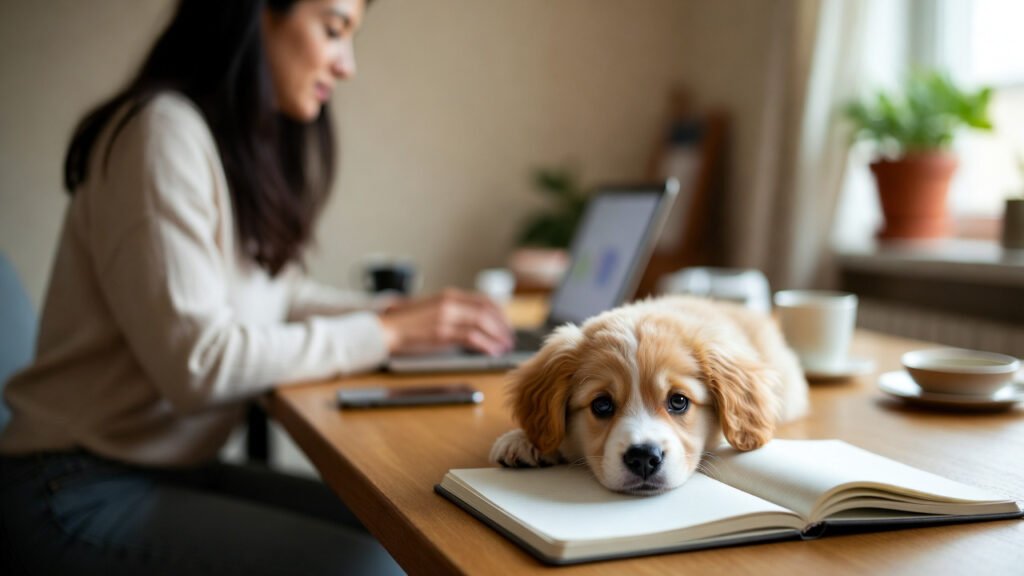
Mastering how to work from home with a puppy starts with a quiet, controlled environment.
1. Understanding Puppy Biology While Working
Before you can master how to work from home with a puppy, you must understand their internal clock. At 11 to 12 weeks, a puppy is essentially a toddler with razor-sharp teeth. They have a physical bladder limit of about 2 to 3 hours, but their mental “focus” limit is much shorter—usually around 15 minutes of active play before they need a change of pace.
The biggest mistake remote workers make is assuming that a puppy should be awake and playing nearby just because you are home. This leads to an overtired, “cranky” puppy who bites harder and barks more. Much like human infants, when puppies get overstimulated, they don’t just fall asleep; they become destructive. Your job as a professional is to be the manager of their energy, ensuring they stay in a calm state so you can stay in a productive one.
2. Creating the Perfect WFH Office Ecosystem
You cannot concentrate on a spreadsheet if you are constantly scanning the floor for accidents. Mastering how to work from home with a puppy requires a “contained” environment. You need to setup a puppy-proof ecosystem that allows the dog to be near you without being “on” you.
The Puppy Pen vs. The Crate
A puppy pen (x-pen) is your most valuable WFH tool. It offers enough room for them to stretch and play with a chew toy, but prevents them from shredding your office chair. If they are in their pen, they learn that ‘office time’ is ‘settle time.’ If you find your puppy is unusually reactive to sounds during your calls, it’s worth checking if they have minor skin irritations like small scabs on dog, as physical discomfort often leads to increased vocalization and stress.
3. The Secret Weapon: Enforced Naps
If you take only one thing from this guide on how to work from home with a puppy, let it be this: 1 hour up, 2 hours down. Puppies need 18-20 hours of sleep per day. Without your help, they will only sleep about 10, leaving them (and you) exhausted. By enforcing naps in a crate or a quiet room, you create “Deep Work” windows for yourself. This is the only way to get through a 2-hour meeting without interruption.
4. The Ultimate Hour-by-Hour WFH Schedule
Consistency is the only way to succeed. Here is a realistic how to work from home with a puppy schedule that balances your 9-to-5 needs with their biological ones.
| Time | Puppy Phase | Your Work Mode |
|---|---|---|
| 7:00 – 8:30 AM | Wake up, Potty, High Play, Training | Morning Prep, Brief Email Check |
| 8:30 – 10:30 AM | Enforced Nap (Crate/Room) | Deep Work Block #1 (Concentrated Tasks) |
| 10:30 – 11:15 AM | Potty, 5-min Training, Solo Play in Pen | Administrative Tasks, Quick Calls |
| 11:15 – 1:15 PM | Enforced Nap | Deep Work Block #2 / Staff Meetings |
| 1:15 – 2:15 PM | LUNCH: Potty, Walk, Lunch, Play | Your Lunch Break (Offline) |
| 2:15 – 4:30 PM | Enforced Nap | Deep Work Block #3 / Focus Time |
| 4:30 – 5:30 PM | Potty, Low-energy play, Settle training | Wrapping up, Planning for Tomorrow |
5. Survival Hacks for Zoom Calls and Presentations
Meetings are the high-stress moments of how to work from home with a puppy. To survive them, you need a “High-Value” toy reserve. This means a specific chew, like a frozen Kong or a lick mat, that the puppy *only* gets when you are on a call. They will soon associate your “meeting voice” with their favorite treats. Also, always check your mute button habit; a sudden bark at the mailman shouldn’t ruin your presentation.
6. Tiring Out a Smart Puppy’s Brain
A smart puppy is a bored puppy, and a bored puppy is an interrupter. To effectively learn how to work from home with a puppy, you must focus on mental exhaustion. Using snuffle mats, frozen toys, and short “training sprints” between emails will tire them out much faster than a long walk. A mentally tired dog will sleep through your afternoon reporting session, giving you the silence you need.
7. Preventing “Velcro Dog” Syndrome
One danger of working from home is that your puppy never learns to be alone. If you are always in the same room, they can develop severe separation anxiety. Practice “fake departures” daily. Put on your coat, grab your keys, and go sit in another room or your car for 20 minutes. They must learn that you leaving is normal and that you always return.
8. Mistakes Every Remote Worker Makes
- The “Short-Order Cook” Syndrome: Stopping work every time the puppy whines. Wait for 10 seconds of silence before rewarding them with attention.
- Skipping the Morning Play: If you don’t drain their energy at 7:00 AM, they will explode at 10:00 AM.
- Overlooking Health: If your puppy is suddenly grumpy or aggressive, they might be in pain. Review behaviors like why is my calm cat suddenly aggressive to see how pain changes pet personalities.
Frequently Asked Questions
Is it okay to work from home with a puppy in the same room?
Yes, but use a pen or a tether so they don’t chew your furniture or cables.
What if my puppy barks during a call?
Ignore it if they don’t need to go potty. Responding to the bark only trains them to bark more for attention.
Should I get a second dog to keep them busy?
No, this usually doubles the work and the noise during your calls!
The Final Verdict
Knowing how to work from home with a puppy is about structure, not just luck. By following a strict 1-hour up, 2-hour down rhythm, you are raising a confident adult dog while maintaining your professional edge. It won’t be perfect every day—there will be accidents and loud barks—but with consistency, you’ll find the harmony you’re looking for. For more tips on living with your pets, join our community on our Facebook page. You’ve got this!