
You have dreamed of this day for months. You picked out the perfect collar, bought the cutest bowls, and watched endless videos of puppies playing. Finally, the day arrived. You brought your bundle of fur home, and the afternoon was filled with cuddles, wet kisses, and adorable photos.
But now, the sun has gone down. The lights are out. And the screaming has started.
It’s not a cute little whimper; it’s a piercing, heartbreaking shriek that sounds like your puppy is being tortured. You are exhausted, frustrated, and maybe even feeling a little bit of “Puppy Blues” regret. You are asking yourself: What have I done? Will I ever sleep again?
If this sounds like your current situation, take a deep breath. You are not alone.
The first night with new puppy chaos is a rite of passage for every dog owner. I have been there, and I promise you, you will survive.
In this comprehensive survival guide, we will explain exactly why your puppy is freaking out, set up a fool-proof bedtime schedule, and answer the ultimate question: Should I let them cry it out?
The Quick Answer: Emergency Checklist
If it is 2:00 AM and you are reading this with one eye open while your puppy howls, here is what you need to do immediately:
🌙 The Sleep Survival List:
Move the Crate: Bring the crate into your bedroom, right next to your bed. They need to hear you breathing.
The “Heartbeat” Hack: If you don’t have a heartbeat toy, wrap a ticking clock in a towel or use a white noise machine.
Potty Check: Take them out for a boring potty break (on a leash, no talking).
Scent Comfort: Put the t-shirt you wore today inside their crate. Your scent signifies safety.
Don’t Get Angry: They are terrified, not naughty. Keep your energy calm.
Understanding the Panic: Why Are They Crying?
To fix the problem, you have to understand the psychology behind the first night with new puppy anxiety.
Until today, your puppy has likely never been alone. Not for a single second. They have spent 24 hours a day sleeping in a warm “puppy pile” with their mother and siblings. They had constant warmth, a heartbeat to listen to, and the safety of numbers.
Today, their entire world changed. They were taken from their family, put in a car, and brought to a strange house with strange smells. And now, you are putting them in a cage (crate) and walking away into the dark.
From their perspective, this is terrifying.
In the wild, a puppy left alone is a dead puppy. Their instinct tells them to cry as loud as possible so the pack can find them. They aren’t trying to annoy you; they are crying out for survival.
Knowing this helps you shift from frustration (“Be quiet!”) to empathy (“I’m here, you’re safe”).
The Setup: Creating a “Zen Den” for Sleep
Success starts before bedtime. If you toss a puppy into a crate in the laundry room and turn off the lights, you are setting yourself up for failure.
1. Location is Everything
For the first night with new puppy (and the first few weeks), the crate should be in your bedroom.
Ideally, place it on a chair or nightstand right next to your head level.
-
Why? You can stick your fingers through the grate to comfort them.
-
Why? You can hear when they actually need to pee vs. when they are just complaining.
2. The “Snuggle Puppy” (A Must-Have)
If you haven’t bought a “Smart Pet Love Snuggle Puppy,” order one now. It is a stuffed toy with a plastic heart inside that beats physically. It mimics the feeling of sleeping with littermates. For many new owners, this is the difference between 2 hours of sleep and 6 hours of sleep.
3. Make the Crate Cozy (But Not Too Big)
The crate should be just big enough for them to stand up and turn around. If it’s too big, they will pee in one corner and sleep in the other.
Line it with:
-
A soft vet-fleece or blanket.
-
An item of your clothing (worn, unwashed) so they are enveloped in your scent.
4. Cover the Crate
Dogs are den animals. Covering the crate with a light sheet (leaving the front open for airflow) makes it feel like a safe, dark cave and blocks visual distractions.
The Perfect Bedtime Schedule
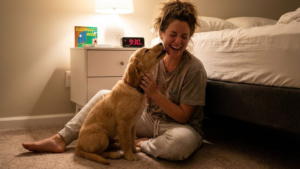
Puppies thrive on routine. You can’t just decide it’s bedtime at random. You need a “wind-down” protocol. Here is the ideal timeline for your first night with new puppy:
🕗 3 Hours Before Bed:
-
Food Cut-off: Pick up the food bowl. This gives their digestive system time to empty before sleep. (Keep water available until 1 hour before bed).
🕘 1 Hour Before Bed:
-
Tire Them Out: This is crucial. A tired puppy sleeps. Engage in gentle play or a short training session. Do not get them hyperactive, but use their brain.
-
Water Cut-off: Remove the water bowl to prevent full bladders at 3 AM.
🕙 Bedtime:
-
The Final Potty: Take them outside. Wait until they go. Praise calmly (don’t get them excited).
-
Into the Crate: Lure them in with a treat. Do not shove them in.
-
Lights Out: Turn off the room lights immediately.
The “Cry It Out” Debate: What Should You Do?
This is the most controversial part of puppy raising. You put them in, you lie down, and the whining begins. It escalates to barking, then screaming.
Should you let them cry it out?
The Old School Advice: “Ignore them completely.”
The Modern Vet Advice: “It depends.”
If you ignore a puppy who is in a state of blind panic, you can create negative associations with the crate and cause separation anxiety. However, if you let them out every time they squeak, you teach them that Crying = Freedom.
The Balanced Approach:
-
The 15-Minute Rule: If they have gone potty and are safe, let them settle. Most puppies will protest for 10-15 minutes and then fall asleep.
-
Soothing, Not Releasing: If they are screaming, drop your hand down to the crate. Speak softly: “Shhh, I’m here.” Put your fingers through the bars. Do not open the door.
-
The “Potty” Cry: If they wake up after sleeping for 2-3 hours and cry, they likely need to pee. Puppies have tiny bladders.
How to Handle the 3 AM Potty Break

When the first night with new puppy includes a middle-of-the-night wakeup call (and it will), you must be boring.
-
Take them out of the crate without speaking.
-
Carry them outside (don’t let them walk/play).
-
Put them on the grass. Say “Go Potty.”
-
Once they finish, pick them up immediately.
-
Put them back in the crate.
-
No treats. No playing. No cuddling. You want them to learn that night is for sleeping and peeing only.
What If They Won’t Stop Crying?
If your puppy has been crying for over 30 minutes despite your presence, or if they are digging frantically at the bars, they might be truly distressed.
Troubleshooting Tips:
-
Check the Temperature: Is the crate too hot or too cold? (Puppies can’t regulate body heat well).
-
White Noise: Turn on a fan or a white noise app on your phone. The silence of a house can be deafening to a puppy used to a noisy litter.
-
Classical Music: Studies show that slow-tempo classical music or reggae calms dogs.
-
Tire Them More: Tomorrow, increase the mental stimulation before bed. A puppy with leftover energy will not sleep.
Frequently Asked Questions (FAQ)
Q: Should I let the puppy sleep in my bed on the first night?
A: It is tempting, but no. If you start this habit, it is very hard to break. Plus, a tiny puppy can fall off the bed or you might roll over on them. It also leads to potty accidents in your bed sheets. Stick to the crate.
Q: How long can a puppy hold their bladder at night?
A: The general rule is age in months + 1. So, a 2-month-old puppy can hold it for about 3 hours. You will need to get up once or twice during the first night with new puppy.
Q: When will they sleep through the night?
A: Most puppies start sleeping for 6-7 hour stretches around 16 weeks (4 months) old. Hang in there; this phase is temporary!
Q: Can I use a playpen instead of a crate?
A: You can, but a crate is better for potty training. A playpen is large enough for them to pee in one corner and sleep in another. A crate encourages them to hold it because dogs don’t like to soil their sleeping area.
Final Thoughts: It Gets Better
If you are reading this with dark circles under your eyes, feeling like you made a mistake: You didn’t.
The first night with new puppy is the hardest night of all. It is the peak of their confusion and your exhaustion. By night three, it will be better. By week two, you will have a routine. And in a few months, you will have a loyal best friend sleeping soundly at your feet.
Stay consistent, stay calm, and keep the coffee machine ready for the morning. You’ve got this!
For more tips on raising a well-behaved dog, check out our [Puppy Training] section to start off on the right paw.