
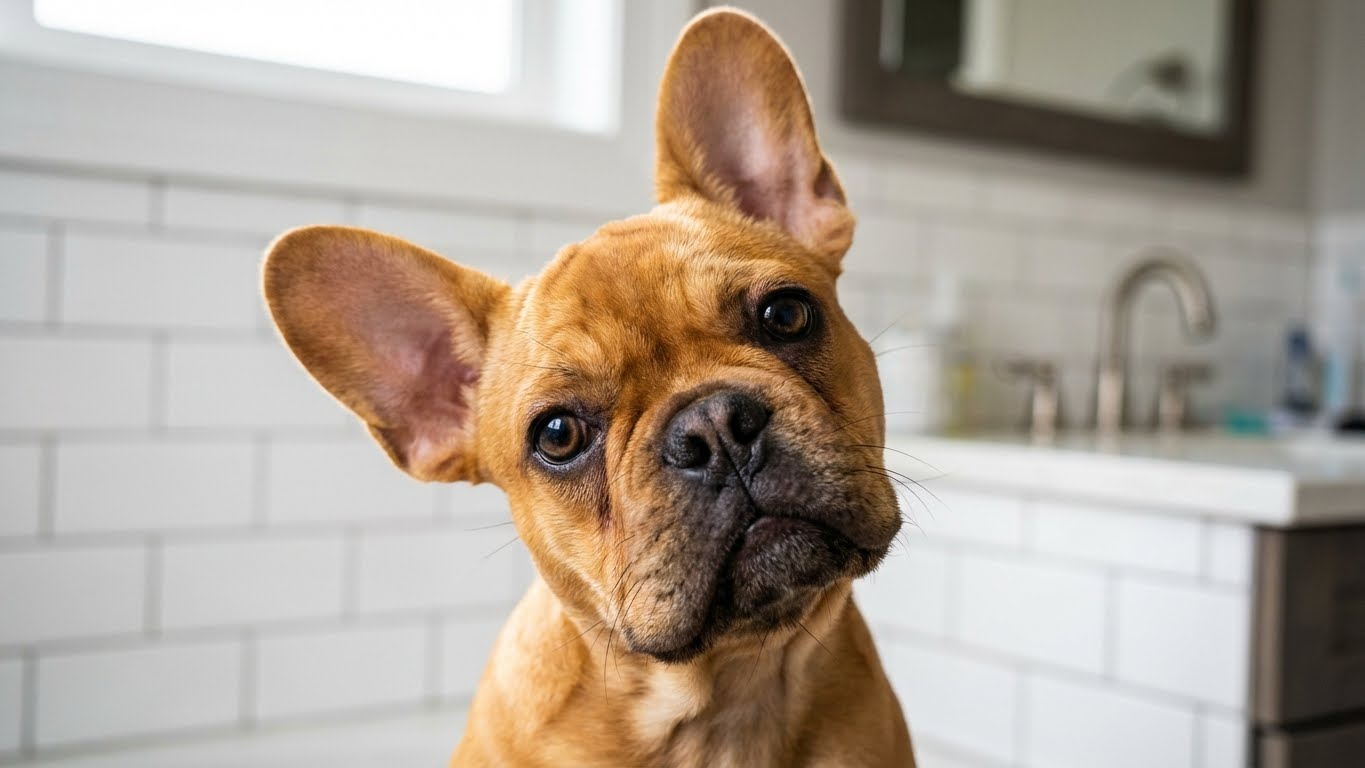
It is a common scenario: you stand up, walk down the hall, and your dog follows you into the bathroom. Why do they refuse to give you privacy?
You are sitting on the couch, enjoying a quiet moment, when nature calls. You stand up, walk down the hall, and step into the bathroom. You turn around to close the door, but you can’t. Why? Because there is a wet nose wedged in the crack, or perhaps a furry body has already squeezed past your legs and is sitting expectantly on the bathmat.
If you manage to close the door in time, the protest begins. The whining, the scratching, the paws sliding under the door gap, or the heavy sigh of a dog collapsing against the wood, waiting for your return.
Let’s be honest: I haven’t used the bathroom alone in ten years. And if you are reading this, chances are, neither have you.
As a pet care expert, this is one of the most common “complaints” (usually said with a smile) I hear from clients. We love our dogs, but everybody needs a little privacy, right?
But have you ever stopped to wonder why they do it? Is it separation anxiety? Is it protection? Or are they just weird?
In this comprehensive guide, we are going to dive deep into the canine brain. We will explore the evolutionary, psychological, and behavioral reasons behind the “Velcro Dog” phenomenon. We will also discuss when this behavior crosses the line from “cute” to “concerning,” and how to gently reclaim your bathroom privacy.
The Quick Answer: Why Do They Do It?
If you are looking for the short answer to “follows you into the bathroom?”, it usually comes down to their instinct as pack animals.
🐶 Quick Summary:
Your dog follows you because:
Pack Instinct: In the wild, animals are vulnerable when doing their business. Your dog is “watching your back.”
Affection: They release oxytocin (the love hormone) when they are near you.
Curiosity (FOMO): The bathroom is a mysterious room with interesting smells and sounds.
Habit: You have likely reinforced the behavior by petting or talking to them in there.
Anxiety: They panic when barriers (doors) separate you from them.
The Science of the “Velcro Dog”: 5 Detailed Reasons
To understand your dog, you have to stop thinking like a human and start thinking like a wolf (or at least, a distant cousin of one). Here is the deep dive into the 5 reasons why your dog refuses to leave your side.
1. The “Pack Protection” Instinct (Vulnerability)
This is the most fascinating evolutionary reason. In the wild, when an animal stops to defecate or urinate, they are in a compromised position. They cannot run or fight easily. It is a moment of extreme vulnerability.
Wolves and wild dogs handle this by looking out for one another. If one member of the pack stops, the others stand guard.
When your dog follows you into the bathroom and sits facing the door (away from you), they are not being rude; they are acting as your personal bodyguard. They are essentially saying:
“You go ahead, human. I’ll make sure no predators attack us while you’re busy.”
(Read more about pack behavior on the AKC website).
This is a huge sign of trust and loyalty. They view you as a member of their pack who is worth protecting.
2. Curiosity and FOMO (Fear Of Missing Out)
Dogs are naturally inquisitive creatures. Their world is defined by smells, sounds, and activities.
Think about the bathroom from your dog’s perspective:
-
You go in there often.
-
You close the door (which makes it “exclusive”).
-
There are strange noises (toilets flushing, showers running, water splashing).
-
There are interesting smells (soaps, towels, and… biological scents).
If your dog is the type who has to investigate every grocery bag you bring home, they likely follow you to the bathroom simply because they have FOMO (Fear Of Missing Out). They want to know what the “pack leader” is doing in that mysterious tiled room.
3. The “Captive Audience” Theory (Reinforcement)
Be honest with yourself: What do you do when your dog follows you into the bathroom?
Do you look at them? Do you say, “What are you doing here, silly?” Do you reach out and scratch them behind the ears while you are sitting there?
If you answered yes, you have trained your dog to follow you.
Dogs are opportunists. They know that when you are sitting on the toilet, you are a “captive audience.” You aren’t cooking, you aren’t typing on your laptop, and you aren’t rushing around. You are sitting still, and your hands are free. To a dog, this is prime petting time!
They have learned a simple equation: Bathroom = Undivided Attention.
4. Separation Anxiety (The Dark Side of Velcro)
While the first three reasons are harmless, this one requires attention. For some dogs, the bathroom door represents a terrifying barrier.
If your dog doesn’t just follow you, but panics when you close the door, this is a sign of Separation Anxiety.
Symptoms of Bathroom Anxiety:
-
Scratching frantically at the door.
-
Whining, barking, or howling the moment the lock clicks.
-
Pacing back and forth outside the door.
-
Accidents (peeing) outside the door.
This isn’t about curiosity; it’s about distress. They cannot handle being separated from you, even for two minutes.
(If you suspect this, check out our detailed guide on [Dog Behavior Problems and Anxiety] for help).
5. Imprinting (Puppy Behavior)
If you have had your dog since they were a puppy, this behavior might be a remnant of “imprinting.” Puppies instinctively follow their mothers (and later, their humans) everywhere to stay safe and learn social cues.
If you never taught your puppy the “Stay” command or never established boundaries when they were young, the habit simply carried over into adulthood. To them, walking with you is just the natural state of being.
Is It a Breed Thing? (Who Does It Most?)
While any dog can be a “Velcro dog,” certain breeds are genetically predisposed to be clingier than others. These “Working” and “Herding” breeds were designed to work closely with humans, so distance feels unnatural to them.
Top “Bathroom Buddy” Breeds:
-
Velcro Vizslas: Literally nicknamed “Velcro dogs” because they must touch you at all times.
-
German Shepherds: High protective instinct makes them want to guard you constantly.
-
Golden Retrievers & Labradors: Their high social drive means they just want to be part of the party.
-
Border Collies: Herding dogs who want to keep the “flock” (you) in sight.
-
Dobermans: Often called “seal skin” dogs because they stick to you like a second skin.
On the flip side, independent breeds like Shiba Inus, Chow Chows, or Greyhounds might be more likely to leave you alone—or just check on you once and then go back to sleep.
Should You Let Them In? (The Pros and Cons)
Is it actually bad to let your dog watch you pee? Scientifically and behaviorally, no, it is not harmful. It really comes down to your personal preference and hygiene boundaries.
The Pros:
-
Bonding: It reinforces the bond between you.
-
Safety Check: You know exactly where your dog is (and that they aren’t chewing your shoes in the other room).
-
Calmness: For anxious dogs, being near you keeps them calm.
The Cons:
-
Hygiene: Bathrooms have germs. If your dog licks the toilet bowl or rolls on the bathmat, that’s gross.
-
Lack of Boundaries: If a dog demands entry, it can lead to pushy behavior in other areas of life.
-
Trip Hazard: Small dogs weaving through your legs in a small room can cause falls.
How to Reclaim Your Privacy (Training Guide)
If you love your dog but miss the days of reading a magazine in peace, you can train them to respect the bathroom boundary. It takes patience, but it is possible.
Here is your “Operation Privacy” plan:
Step 1: The “Stay” Command
This is the most effective tool.
-
Walk towards the bathroom.
-
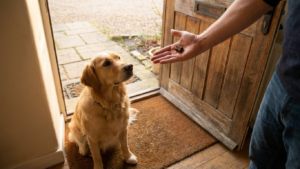
Before you enter, turn to your dog and give the “Sit” and “Stay” command right outside the threshold.
-
Enter the bathroom but leave the door open.
-
If they wait, toss a high-value treat to them (outside the door).
-
Reinforce: “Good Stay!”
Step 2: Desensitizing the Door
If the closed door triggers them, you need to break that association.
-
Throughout the day (not just when you need to go), walk to the bathroom.
-
Go inside, close the door for 1 second, then open it immediately.
-
Toss a treat.
-
Gradually increase the time: 5 seconds, 10 seconds, 30 seconds.
-
They will learn that the door always opens again, and waiting yields a reward.
Step 3: Create a “Distraction Station”
If your dog follows you out of boredom, give them something better to do.
-
Keep a jar of treats or a puzzle toy near the bathroom.
-
When you go in, give them a Kong filled with peanut butter or a lick mat outside the door.
-
This changes the association from “I’m being left alone” to “Yay, I get a snack!”
Step 4: The Baby Gate Solution
If training is going slowly, use a baby gate. Install it in the doorway.
-
This allows the dog to see and smell you (reducing anxiety).
-
But it keeps them physically out of your space.
When to See a Vet: Sudden Clinginess ⚠️
While following you is usually a quirk, a sudden change in behavior is a red flag.
If your independent dog suddenly becomes a Velcro dog who won’t leave your side, it could indicate a medical issue.
Watch for these signs:
-
Illness: Dogs often cling to their owners when they feel nauseous, dizzy, or in pain.
-
Vision Loss: As dogs age, they lose their sight. They may follow you closely because they are using you as a guide to navigate the house.
-
Cognitive Dysfunction (Dementia): In senior dogs, getting “lost” or feeling confused can make them clingy. If your senior dog follows you into the bathroom and then stares at the wall or seems stuck, consult your vet.
Pro Tip: If you notice sudden behavioral changes, check our [Senior Dog Health] category for more symptoms to watch for.
Frequently Asked Questions (FAQ)
Q: Does my dog think he is the alpha if he follows me?
A: No. The “Alpha theory” has been largely debunked by modern science. Your dog isn’t trying to dominate you by watching you pee; they are seeking connection, safety, or treats. It is an affiliative behavior, not a dominant one.
Q: Why does my dog look away when I’m on the toilet?
A: This is polite dog language! In the dog world, staring directly at someone can be seen as a threat or a challenge. By sitting with you but looking away (or leaning against you), they are showing you respect and granting you privacy while still guarding you.
Q: Do cats do this too?
A: Yes! But usually for different reasons. Cats are notoriously curious and hate closed doors because it cuts off their territory. They also love the cool tiles or playing with the toilet paper. (See our article on [Cat Behavior & Psychology] for more on this).
Q: My dog licks my legs when I’m on the toilet. Why?
A: This is usually a sign of affection (grooming behavior) or simply because they like the taste of the salt on your skin (sweat). While weird to us, it’s a compliment from them!
Final Thoughts
So, the next time you look down and see a pair of puppy eyes staring up at you in the bathroom, don’t be annoyed. Take it as a compliment.
In a world that is big and sometimes scary, your dog has decided that you are their safety, their pack, and their favorite person. They are willing to sit on a cold bathmat just to be near you.
And honestly? That kind of loyalty is worth sacrificing a little bit of privacy for.
If you found this guide helpful, you might also want to read our tips on [How to Stop Puppy Separation Anxiety] to ensure your dog’s attachment remains healthy and happy.